The Cartography of Memory: The Art of Elias Uldarico Adasme Apablaza
Born in the Chilean town of Illapel in 1955, Elias Uldarico Adasme Apablaza emerged as a profound witness to one of the most turbulent eras in South American history. His artistic identity is inextricably woven into the fabric of political upheaval and the visceral experience of exile. As a student at the Universidad de Chile between 1974 and 1979, Adasme entered the intellectual landscape just as the shadow of Augusto Pinochet’s coup d'état began to descend upon his homeland. This period of intense censorship and social fracture did not merely serve as a backdrop to his education; it became the very catalyst for his creative evolution. Witnessing the systematic erasure of intellectual thought—where even the most fundamental philosophical texts were purged from libraries—Adasme developed a lifelong commitment to using art as a vessel for truth, memory, and resistance against oblivion.
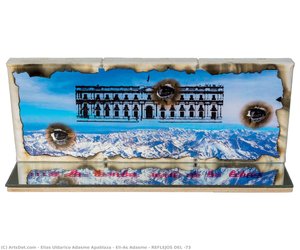
As his practice matured, Adasme underwent a radical transformation, moving away from the traditional confines of painting toward the expansive, boundary-pushing realm of conceptualism. He recognized that to combat the repression of his era, he needed a language that could transcend the physical canvas. This led him to embrace a diverse and multidisciplinary toolkit, ranging from installations and performances to digital graphics, visual poetry, and the intimate, subversive medium of mail art. His work became less about the depiction of objects and more about the articulation of ideas, seeking to build a universal artistic language rooted in humanistic nuances. In his vision, art serves as a sanctuary where memory takes precedence over oblivion and freedom triumphs over oppression.
Exile and the Monumental Act of Defiance
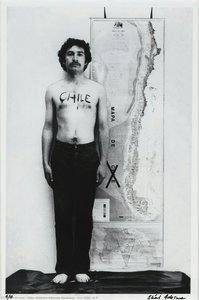
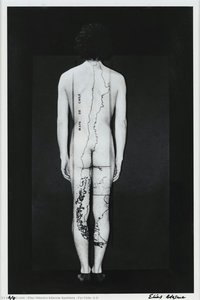
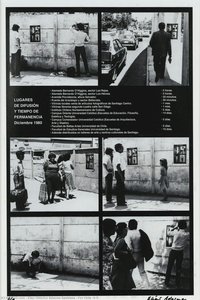
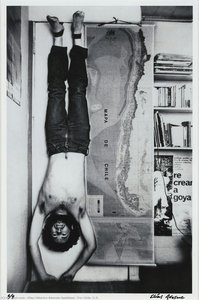
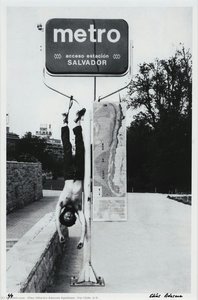
The year 1982 marked a definitive turning point in Adasme’s career and his relationship with his nation. With the presentation of his monumental work, ‘A Chile (To Chile)’, at the Paris Biennale, he achieved international recognition while simultaneously performing a profound act of political protest. This project was characterized by a deliberate and poignant refusal to exhibit within the borders of Chile, a decision that transformed his personal experience of displacement into a potent symbol of national mourning and resistance. Through this work, Adasme established a metaphorical connection between his own physical body and the very map of Chile, utilizing interventions in both public and private urban spaces to reclaim a sense of identity that the regime sought to dismantle.
The consequences of such defiance were immediate and harrowing. As the Chilean authorities tracked political opponents, Adasme faced escalating death threats, ultimately forcing him into a life of exile in 1983. Settling in Puerto Rico, where he has resided for decades, his work continued to evolve, yet it never lost its connection to the historical repercussions of his homeland. His residency in Puerto Rico allowed him to continue his role as an educator and essayist, sharing his insights with new generations while maintaining a creative discourse that bridges the gap between the trauma of the past and the possibilities of the future.
A Legacy of Social Justice and Humanism
The enduring significance of Elias Adasme lies in his ability to transform the pain of displacement into a sophisticated exploration of social justice. His oeuvre is not merely a collection of aesthetic objects but a series of signs erected to struggle for libertarian expression. Whether through the ephemeral nature of performance or the structured complexity of digital installations, his work remains focused on the tension between historical evolution and the individual's struggle for dignity.
Throughout his illustrious career, Adasme has been recognized by prestigious institutions, receiving support from the National Endowment for the Arts and the Rockefeller Foundation. His contributions to the contemporary art world are defined by several key pillars:
- The Exploration of Identity: Using the self as a site of political inquiry to understand the impact of borders and displacement.
- Conceptual Versatility: The seamless integration of mail art, digital media, and installation to challenge conventional artistic boundaries.
- Ethical Commitment: A steadfast dedication to an ideology of social justice, ensuring that the voices of the silenced are heard through visual poetry and graphic intervention.
Today, Adasme stands as a singular voice in Chilean contemporary art, a master of mapping the invisible territories of memory and a tireless advocate for the power of the human spirit to endure through the darkest of political winters.