The Soul of the Urban Canvas: The Art of Emmanuel Jarus
In the vast, often impersonal expanse of our modern urban landscapes, there exists a profound movement to reclaim public space through the power of human connection. At the forefront of this transformation is Emmanuel Jarus, a Canadian artist whose monumental murals serve as windows into the quiet, contemplative depths of the human experience. Born in 1992 in Regina, Saskatchewan, and raised amidst the sweeping vistas of Saskatoon, Jarus’s artistic identity was forged through a unique blend of classical discipline and the raw, rebellious energy of street art. His journey began not in a formal studio, but on the moving canvases of freight trains crossing the Canadian prairies, where his early portraits and figures captured the imagination of a global digital audience.
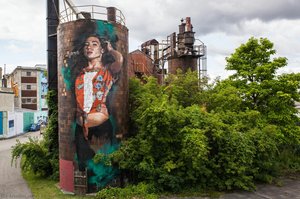
The evolution of Jarus’s style is a testament to his ability to bridge disparate worlds. While his roots lie in the spontaneous act of painting transit cars, his technical foundation was solidified at the Academy of Realist Art in Toronto. This rigorous training allowed him to infuse the ephemeral nature of graffiti with the timeless precision of classical realism. Today, his work is characterized by a striking photorealism that breathes life into concrete and steel. He possesses a rare ability to capture subjects—often women or individuals encountered during his global travels—in moments of profound introspection, making the viewer feel as though they have stumbled upon a private, sacred thought frozen in time.
Technique and the Alchemy of Color
To witness a Jarus mural is to observe a masterclass in textural layering and medium integration. He does not merely paint; he builds surfaces that demand engagement. By blending the fluid, atmospheric qualities of aerosol spray paint with the controlled, meticulous application of acrylics, latex, and even oil techniques, he achieves a depth that transcends the flat plane of a wall. This alchemy allows him to create skin tones that glow with warmth and eyes that hold an uncanny, lifelike spark.
His palette is never accidental. Drawing deep inspiration from the natural environments surrounding his projects—be it the rugged textures of Canada or the vibrant light of Mexico—Jarus uses color as a narrative tool. He often employs:
- Luminous highlights that simulate the play of natural sunlight on skin.
- Deep, atmospheric shadows to create a sense of three-dimensional volume within a two-dimensional space.
- Cultural symbolism woven through color choices that resonate with the specific history and identity of the local community.
A Global Dialogue and Lasting Legacy
Beyond the technical brilliance, the true significance of Emmanuel Jarus lies in his commitment to participatory art. He views the muralist not as a solitary creator, but as a storyteller for the community. His practice involves an active engagement with the people whose lives are reflected in his work, ensuring that his large-scale portraits encapsulate local histories, aspirations, and everyday realities. This approach has allowed him to transform silos, blank walls, and urban corridors into open-air galleries that foster dialogue and social reflection.
His reach is truly international, with a portfolio that spans continents. From the streets of Guatemala and Mexico City to prestigious festivals in Montreal, Calgary, and Berlin, Jarus has left an indelible mark on the global street art scene. One of his most historic achievements includes a monumental mural in Manhattan, created for the 75th anniversary of the United Nations, a project that underscored his ability to use art as a tool for international unity. As he continues to travel and create, Jarus remains dedicated to his core belief: that art belongs in the public square, serving as a vital catalyst for bringing people together and telling the stories that define us all.