The Sculptural Legacy of Enrico Napoleone Mazzolani
In the vibrant tapestry of early 20th-century Italian art, few figures embody the delicate tension between classical tradition and emerging modernism as poignantly as Enrico Napoleone Mazzolani. Born on March 27, 1876, in the coastal town of Senigallia to noble parents, Mazzolani’s life was a journey through the very heart of Italian aesthetic evolution. While his name may not resonate with the same immediate global recognition as the titans of the Renaissance, his work serves as a vital bridge between the rigid academicism of the late 19th century and the more fluid, expressive sensibilities that would define the coming decades. His artistic path was shaped by a restless spirit, moving from the classical foundations of Rome to the innovative ceramic workshops of Faenza, eventually finding a home in the bustling creative atmosphere of Milan.
Mazzolani’s formative years were marked by a rigorous engagement with the masters. After an initial period of classical studies, he sought the transformative atmosphere of Rome in 1897, where he attended the scuola libera del nudo at the Accademia di Belle Arti. It was here that he served as an assistant to the renowned sculptor Ettore Ferrari, an experience that undoubtedly deepened his understanding of form, anatomy, and the monumental weight of classical sculpture. However, Mazzol ani’s heart yearned for a more tactile and versatile medium. This led him to Faenza, where he entered the workshop of Salvatore Farina. In this environment, the sculptor began to embrace the delicate art of ceramics, collaborating on religious lunettes and architectural decorations that showcased his ability to marry structural strength with the sinuous, polished elegance characteristic of the period.
A Synthesis of Form and Symbolism
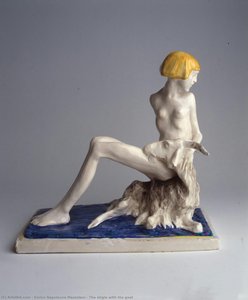
The true brilliance of Mazzolani lies in his ability to infuse physical matter with profound spiritual and emotional resonance. His work often transcends mere representation, reaching toward a symbolic language that speaks to the universal human experience. This is perhaps most exquisitely realized in his celebrated 1932 masterpiece, "The Virgin with the Goat." Housed within the serene Villa Borghese Gardens in Rome, this sculpture stands as a testament to his mastery of classical idealism blended with a poignant, evocative emotionalism. By depicting Mary cradling the infant Jesus alongside a goat—a deliberate biblical allusion to innocence and sacrifice—Mazzolani created a work that is both visually arresting and intellectually profound.
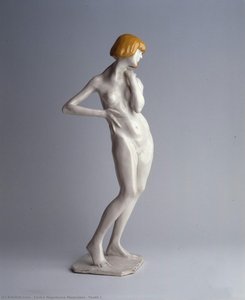
Beyond his monumental sculptures, Mazzolani’s versatility allowed him to explore various scales and materials, from the architectural grandeur of ceramic lunettes to the intimate detail of small-scale works like "Giovinezza I." His time in Milan, working alongside architects and participating in prestigious exhibitions such as the 1925 Biennale di Monza, allowed him to integrate his sculptural sensibilities into the broader decorative arts movement. His ability to manipulate materials—whether the permanence of stone or the delicate glaze of maiolica—ensured that his artistic voice remained distinct, characterized by a preference for smooth, flowing lines and a refined sense of grace.
Historical Significance and Artistic Spirit
The historical significance of Enrico Napoleone Mazzolani resides in his role as a custodian of tradition during an era of radical change. As Italy navigated the complexities of nationalism and the rise of modernism, Mazzolani remained anchored in the aesthetic principles of the past while simultaneously embracing the decorative innovations of the present. His career, which spanned from the late 19th century until his passing in Milan in 1968, reflects a lifelong commitment to the pursuit of beauty through craftsmanship.
To study Mazzolani is to encounter an artist who viewed sculpture not merely as the shaping of medium, but as a way to capture the ephemeral essence of life. His legacy is found in:
- The preservation of classical technique: Maintaining the rigorous standards of the Florentine and Roman academies within a modern context.
- The mastery of diverse media: Seamlessly transitioning between the monumental demands of sculpture and the intricate, decorative possibilities of ceramics.
- Symbolic depth: Utilizing religious and natural motifs to communicate complex themes of sacrifice, youth, and divinity.
Through his hands, the heavy weight of stone and the fragile surface of clay were transformed into enduring narratives of the human soul.