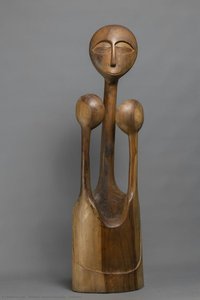
The Visionary Legacy of Erhabor Ogieva Emokpae
In the vibrant tapestry of Nigerian modernism, few threads shine as brightly or as complexly as those woven by Erhabor Ogieva Emokpae. Born in 1934 within the historic walls of Benin City—the ancestral heart of the Edo Kingdom—Emokpae was a child of profound cultural duality. His lineage provided a unique vantage point for an artist; his father, Ewekagosadoba, held a distinguished position within the royal court, anchoring him to the grandeur of Bini heritage, while his mother’s Muslim faith introduced him to a different spiritual and aesthetic rhythm. This early immersion in the traditions of the Edo people, contrasted with a broader, multicultural upbringing, would later become the cornerstone of his artistic exploration into themes of dualism and identity.
Emokpas's journey toward mastery was marked by a rigorous pursuit of both local tradition and international innovation. After completing his early education at Western Boys High School in Benin, he sought formal technical training at the Yaba Trade Centre, now known as the Yaba College of Technology, between 1951 and 1953. However, it was his voyage to England in 1963 that would fundamentally reshape his creative lens. Immersed in the European avant-garde, Emokpae absorbed the haunting psychological depths of Surrealism and the raw, emotive power of Expressionism. This transatlantic dialogue allowed him to return to Nigeria not merely as a practitioner of traditional forms, but as a modern pioneer capable of translating African narratives through a globalized, contemporary aesthetic.
A Synthesis of Form and Symbolism
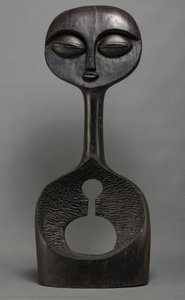
As a multidisciplinary force, Emokpae refused to be confined by a single medium. He moved with equal grace between the tactile world of sculpture, the expansive plane of muralism, and the precise discipline of graphic art. His work often functioned as a bridge between the ancient and the modern, utilizing stylized forms to evoke deep-seated cultural memories. One can see this mastery in his ability to reduce features to their most potent essences—slits for eyes or thin lines for lips—creating a sense of serene, almost otherworldly, presence that invites the viewer into a meditative state.
His contributions to Nigeria's visual landscape are perhaps best exemplified by several monumental achievements:
- The FESTAC '77 Emblem: Perhaps his most iconic contribution to global African culture was the creation of the bronze replica of the Benin ivory mask. This work served as the official emblem for the Second World Black and African Festival of Arts and Culture, a moment of immense pride for the continent.
- National Arts Theatre Decorations: Emokpae left an indelible mark on the architecture of Lagos itself, being responsible for the striking frieze decorations at the four entrances of the National Arts Theatre, integrating fine art into the very fabric of public space.
- Iconic Portraiture: His oil painting of Queen Amina stands as a testament to his ability to blend historical reverence with a powerful, modern painterly technique, capturing the strength and legend of the Zazzau warrior queen.
The Architect of Modern Nigerian Identity
Beyond the physical beauty of his sculptures and paintings, Emokpae’s significance lies in his role as a cultural diplomat and institutional builder. His professional trajectory, which included influential roles at the Ministry of Information and as Creative Director for Lintas West Africa, allowed him to shape the visual language of Nigerian commerce and communication. Through his involvement with the Society of Nigerian Artists, he championed the necessity of a robust, self-sustaining artistic dialogue that could command respect on the international stage.
Though his life was tragically short, ending in 1984 at the age of forty-nine, the impact of Erhabor Ogieva Emokpae remains undiminished. He did not merely paint or sculpt; he constructed a visual vocabulary for a nation finding its voice in the post-colonial era. By weaving together the regal traditions of Benin, the spiritual nuances of his upbringing, and the experimental freedoms of European modernism, he ensured that Nigerian art would forever be recognized as a profound, multifaceted, and essential component of the global human experience.