The Quiet Observer: The Life and Art of Ernst Willem Jan Bagelaar
In the annals of Dutch art history, certain names resonate with the thunder of grand canvases and theatrical drama, yet there exists a profound, quieter beauty in the works of Ernst Willem Jan Bagelaar. Born in Eindhoven in 1775, Bagelaar’s life was not initially destined for the studio, but rather for the disciplined rigors of military service. As a young man, he entered the Dutch army, where his duties in topographical surveying provided him with a unique and invaluable vantage point. This early immersion in the precise mapping of landscapes instilled in him a meticulous eye for detail and a technical discipline that would later become the hallmark of his artistic identity. Through the lens of a surveyor, he learned to perceive the subtle contours of the earth, a skill that would eventually transition from the military ledger to the copper plate.
The transformation from soldier to artist was a journey of profound intellectual and aesthetic discovery. While serving abroad, Bagelaar’s travels through Germany and his formative stay in Paris exposed him to the vibrant pulse of European fine arts. It was during these wanderings that he began to cultivate a deep fascination with the medium of etching, finding in its delicate lines a way to capture the ephemeral nuances of nature. He did not merely seek to record what he saw; he sought to interpret it through a lens of classical reverence. This period of self-instruction and exploration allowed him to move away from the rigid structures of military life toward a contemplative practice rooted in the art of imitation and the faithful reproduction of natural beauty.
A Legacy Etched in Line and Light
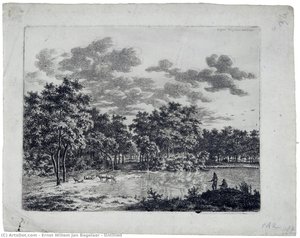
Bagelaar’s artistic output, comprising over 300 etchings and drawings, is characterized by an extraordinary devotion to the landscapes of his homeland and beyond. His technique was deeply influenced by the legendary Jan Luyken, whose intricate engravings and detailed natural scenes served as both a blueprint and an inspiration for Bagelaar’s own hand. Much like Luyken, Bagelaar mastered the use of careful hatching and sophisticated shading to breathe life into texture and depth. His works often feel like intimate dialogues with the landscape, where every stroke of the needle on the plate serves to emphasize the serene, almost meditative atmosphere of the Dutch countryside.
While many of his etchings were executed in imitation of existing drawings—a practice that speaks to his profound respect for the masters of the past—his true genius lay in his ability to infuse these reproductions with a singular, quiet vitality. His repertoire was remarkably diverse, ranging from pastoral scenes and maritime studies to more complex compositions inspired by the greats:
- Landscape Mastery: His many depictions of Eindhoven’s surroundings and views such as those of Arnheim, often drawing inspiration from the compositional principles of Schelfhout.
- Animalier Studies: A notable collection of plates featuring cows, heavily influenced by the style of A. Cuyp, which remain among his most celebrated works for their ability to capture the soft, organic forms of livestock.
- Classical and Biblical Narratives: Etchings such as Ruth and Boaz and Daniel in Prayer, where he utilized the stylistic charm of Luyken to explore themes of devotion and drama.
- Maritime Impressions: Sea-pieces and storm scenes that demonstrate his ability to translate the turbulent energy of water through the controlled medium of etching.
Ultimately, Bagelaar’s significance lies in his role as a bridge between the meticulous topographical traditions of the late 18th century and the romanticized landscape sensibilities of the early 19th century. He retired to his property at Zon, near Eindhoven, where he lived out his final years until his death in 1837. Though he may not have sought the spotlight of the grand exhibitions, his legacy survives in the delicate, enduring textures of his prints—a testament to a life spent finding the extraordinary within the quiet, observed details of the natural world.