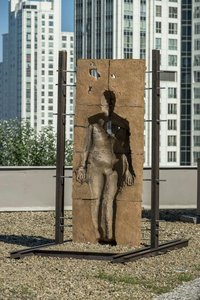
The Sculptor of Anatolian Forms
Emerging from the ancient, storied landscapes of Beypazarı, Ankara, Ersin Uysal carries within his creative DNA the profound weight of Turkish history. Born in 1958, Uysal’s journey is one deeply rooted in a region where geological grandeur and cultural heritage intersect. His formative years were shaped by an environment steeped in tradition, yet his intellectual curiosity led him toward the cutting edge of contemporary expression. This duality—a respect for the ancestral and a drive toward the avant-garde—defines much of his artistic identity. Before establishing himself as a master of stone, Uysal navigated diverse intellectual waters, working as a journalist, sports writer, and translator. This multifaceted engagement with language and communication undoubtedly enriched his sculptural practice, allowing him to approach form not merely as physical matter, but as a silent, powerful vocabulary capable of conveying complex human narratives.
Uysal’s formal artistic foundation was forged at the prestigious Marmara University Fine Arts Faculty. It was within these academic halls that he refined his technical mastery and developed the conceptual frameworks that would later allow him to transcend conventional boundaries. His education provided more than just a toolkit of sculptural techniques; it instilled in him an inquisitive spirit that sought to push beyond representational imagery. Rather than seeking to mimic the world as it appears, Uysal turned his gaze toward the essence of form itself, finding inspiration in the abstract and the elemental.
Materiality and the Language of Stone
The heart of Uysal’s practice lies in a profound, almost spiritual dialogue with his medium. Eschewing the literal for the abstract, he prioritizes the manipulation of stone to evoke deep emotional resonance and intellectual contemplation. His work is characterized by a meticulous approach to carving and shaping, particularly when working with basalt. Through a disciplined process of texture creation, he transforms dense, heavy minerals into surfaces that interact dynamically with light and shadow. These textured landscapes within his sculptures capture the fleeting nuances of illumination, lending a sense of movement to otherwise static objects.
His aesthetic is one of deliberate simplicity, rooted in the principles of minimalism. By stripping away the superfluous, Uysal allows the inherent qualities of the stone—its weight, its grain, and its ruggedness—to speak. This minimalist approach serves a greater purpose: it creates a space for the viewer to engage with themes of balance and transformation. His compositions often evoke the geological history of Anatolia, subtly referencing the rugged terrains and ancient landscapes of his homeland. In doing so, he bridges the gap between the physical earth and the metaphysical concept, creating works that feel both grounded in reality and elevated by imagination.
Themes of Nature and Human Connection
Beyond the technical mastery of his craft, Uysal’s work is a continuous exploration of the relationship between humanity and the natural world. His sculptures serve as meditations on several recurring motifs:
- Balance and Equilibrium: The careful arrangement of heavy, organic forms to suggest a precarious yet harmonious state of being.
- Transformation: The way raw, unyielding stone is transitioned through human touch into something evocative and poetic.
- Anatolian Resonance: A subtle, atmospheric connection to the myths and geological legacies of the Turkish landscape.
Through these themes, Uysal achieves a historical significance that transcends his personal biography. He does not merely create objects; he creates vessels for memory and contemplation. His ability to weave the ancient spirit of Beypazarı into the language of modern abstract sculpture ensures that his work remains a vital part of the contemporary sculptural dialogue, offering a timeless reflection on the enduring strength and beauty of the natural world.