The Alchemist of the Everyday: The Life and Vision of Evan Charlton
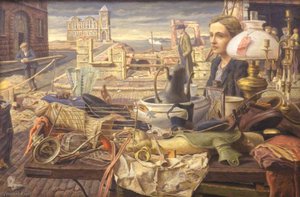
Evan Charlton (1904–1984) occupied a singular space in the mid-century British art scene, acting as a bridge between the grounded precision of realism and the ethereal whispers of surrealism. Born in London to Welsh parents, his early life was marked by an unexpected intellectual foundation; before ever picking up a brush with professional intent, Charlton studied chemistry at University College London. This scientific background perhaps gifted him with a unique, analytical eye—a way of observing the structural integrity of light and form that would later define his mastery of texture and composition. His journey from the laboratory to the studio was catalyzed by the influence of his brother, George, a teacher at the prestigious Slade School of Art, whose invitation to sketch during a summer break paved the way for Charlton’s formal training between 1930 and 1933.
At the Slade, Charlton refined a technique that balanced meticulous observation with an expressive, almost tactile application of paint. Under the tutelage of masters such as Henry Tonks and Philip Wilson Steer, he learned to navigate the complexities of the human figure and the landscape alike. This period of academic rigor provided him with the tools to capture not just the surface of reality, but its underlying emotional resonance. His early success, marked by winning the Slade Prize, signaled the arrival of an artist capable of profound atmospheric storytelling.
From War Documentation to Surrealist Dreamscapes
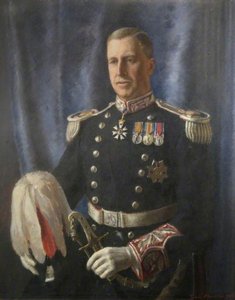
The trajectory of Charlton’s career was irrevocably shaped by the tremors of the Second World War. Commissioned by the War Artists' Advisory Committee, he stepped away from purely personal explorations to document the grit and gravity of the era. His work during this time—ranging from industrial scenes to intimate portraits of ordinary Britons—infused his art with a deep sense of social responsibility and an acute understanding of the human condition under pressure. These experiences grounded his later, more fantastical works in a recognizable, lived-in reality.
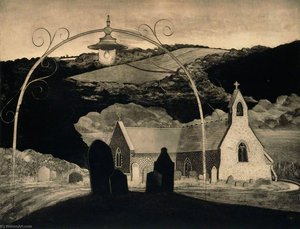
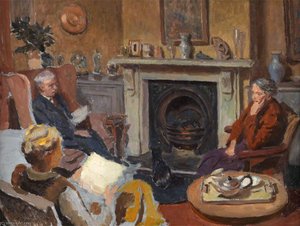
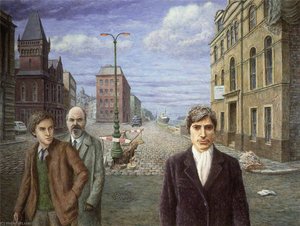
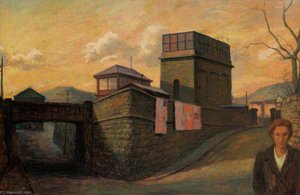
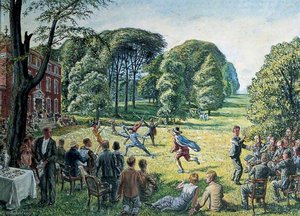
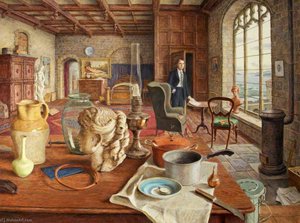
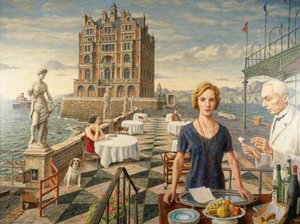
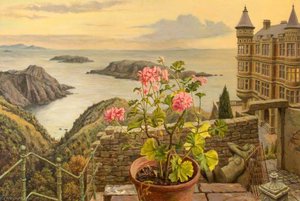
Following the war, Charlton’s work began to drift into more enigmatic territories. While he remained a master of the domestic interior, he increasingly infused these quiet spaces with elements of the uncanny. In masterpieces such as “The Artist’s Family at Llandaff” (1947), one finds a breathtaking duality: the warmth of a cozy home is rendered through rich, textured impasto and expressive lines, yet there remains an underlying sense of stillness that borders on the dreamlike. This ability to juxtapose domestic tranquility with unsettling, surrealist undertones became his hallmark. In landscapes like “Station Road” (1949), the familiar becomes strange, as if the viewer is peering through a veil into a world where time and space have subtly shifted.
A Legacy of Education and Artistic Stewardship
Beyond the canvas, Charlton was a pillar of the British artistic community, dedicating much of his life to the cultivation of future generations. His tenure at the West of England College of Art in Bristol was not merely a period of teaching but one of profound connection, as it was here he met his wife, the equally talented artist Felicity Charlton. Their lives and careers became intertwined in a shared devotion to art, eventually leading him to serve as the Head of the Cardiff School of Art in 1938.
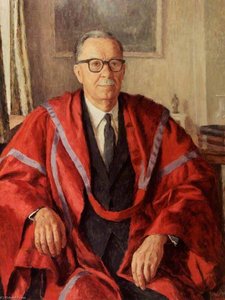
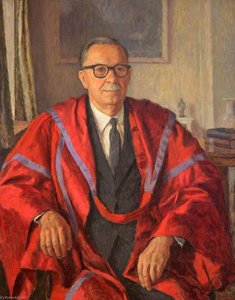
His commitment to the arts extended into the highest levels of administration. As Her Majesty's Inspector of Art for Wales, Charlton played a pivotal role in shaping art education and fostering appreciation across the region. This period of stewardship allowed him a rare freedom; upon his retirement from the Civil Service in 1964, he returned to full-time painting with a renewed vigor. His later years were characterized by an uninhibited exploration of his dualistic style, exhibiting at prestigious venues such as the Royal West of England Academy and the New English Art Club.
Today, the significance of Evan Charlton lies in his refusal to be confined by a single movement. He remains a vital figure for those who find beauty in the intersection of the tangible and the imagined. His legacy is preserved not only in the galleries that house his evocative landscapes and portraits but also in the enduring spirit of artistic inquiry he championed throughout his life.