The Silent Master of the Ink Brush
In the quietude of the thirteenth century, amidst the shifting political landscapes of the Southern Song dynasty, a singular voice emerged from the monastic retreats of China to redefine the boundaries of visual expression. Fachang, known more intimately to history by his pseudonym Muqi, was not merely a painter but a practitioner of the Chan Buddhist path, whose brushstrokes served as an extension of meditative contemplation. Born around 1210 in the Sichuan region, his life was deeply intertwined with the spiritual rhythms of Zen Buddhism. While historical records suggest he may have faced political turbulence that eventually led him to seek refuge in monasteries near Hangzhou, it is within this sanctuary of stillness that his artistic identity was forged. His work does not shout; rather, it whispers truths of the natural world, inviting the viewer into a state of profound, wordless awareness.
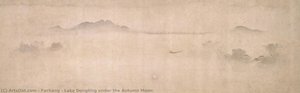
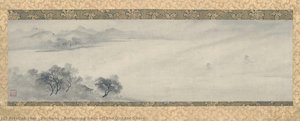
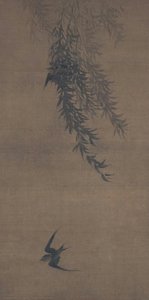
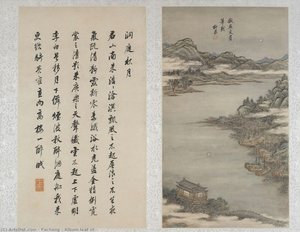
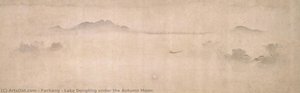
The essence of Muqi’s artistry lies in the radical simplicity of his technique, a method that eschewed the ornate complexities of contemporary court painting in favor of tonal gradation and spontaneous energy. He mastered the art of using varying shades of ink to suggest depth, moisture, and atmosphere, creating a sense of space that feels both infinite and intimately present. This approach was deeply rooted in Chan philosophy, where the goal is to capture the essence or "true nature" of a subject rather than its superficial details. Whether depicting the weight of a ripening fruit or the delicate tremble of a bird on a branch, Muqi utilized loose, expressive brushwork that allowed the spirit of the subject to breathe through the silk.
A Legacy Written in Mist and Monochrome
Though his reception in China was occasionally polarized—with some critics dismissing his minimalist style as "coarse"—his influence found its most fertile ground across the sea in Japan. The Zen monks traveling between China and Japan became the primary conduits for his vision, carrying his ink washes into the heart of Japanese aesthetic development. This cross-cultural transmission ensured that Muqi’s style became a cornerstone of sumi-e painting, shaping the very soul of Japanese landscape and naturalist traditions for centuries to come.
The breadth of his achievement is best understood through his most iconic compositions, which continue to haunt the halls of the world's greatest museums:
- Six Persimmons: Perhaps his most celebrated triptych, this work exemplifies the pinnacle of Southern Song landscape painting. Through subtle washes of ink, he captures the heavy, succulent presence of fruit against a backdrop of ethereal mist, turning a simple botanical study into a profound meditation on existence.
- The White-Robed Guanyin: A masterful triptych that juxtaposes the divine with the earthly, featuring the serene Bodhisattva flanked by the spontaneous movements of monkeys and a crane, illustrating the interconnectedness of all sentient beings.
- Naturalistic Studies: His ability to imbue everyday subjects—such as sparrows, bamboo, and water—with a sense of immediate vision helped establish a new vocabulary for ink painting that prioritized the momentary encounter over formal iconography.
Ultimately, the historical significance of Fachfang (Muqi) transcends the boundaries of art history. He remains a bridge between the spiritual and the visual, a master who proved that through the reduction of form, one can achieve an expansion of spirit. His paintings do not merely represent nature; they participate in its quiet, ongoing creation, leaving behind a legacy of peace that resonates as powerfully today as it did in the thirteenth century.