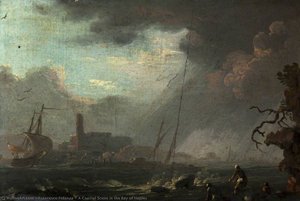
The Ethereal Landscapes of Francesco Fidanza
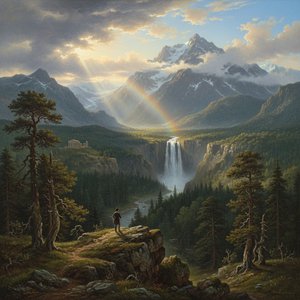
In the annals of Italian landscape painting, few names evoke the quiet drama of the natural world as poignently as Francesco Fidanza. Born in Rome in 1747, Fidanza emerged during a transformative era when the rigid structures of classicism began to yield to the emotive, atmospheric depths of Romanticism. His life and work serve as a bridge between eras, capturing a sense of the sublime that resonates through the mist-covered coasts and moonlit shores he so meticulously rendered. To study his canvases is to step into a world where light does not merely illuminate objects but breathes life into the very atmosphere, creating a dialogue between the tangible earth and the intangible spirit.
Fidanza’s artistic foundation was laid in the prestigious studios of Rome, where he studied under masters such as Vincenzo Camuccini and Francesco Podesti. However, it was his exposure to the works and techniques of Claude Joseph Vernet and Charles-François Lacroix de Marseille that truly sculpted his visual language. From these influences, he inherited a profound fascination with maritime vistas and the complex interplay of light upon water. This training allowed him to master the art of atmospheric perspective, a technique that would become his hallmark, enabling him to depict vast distances and the heavy, moisture-laden air of coastal environments with startling realism.
A Mastery of Light and Maritime Grandeur
The zenith of Fidanza’s professional achievements can often be found in his monumental collaborations. Working alongside Eugène Beauharnais, he contributed to significant harbor scenes that remain celebrated today. His depictions of the Italian ports of Ancona and Malamocco are not merely topographical records but emotional explorations of maritime life. These works, currently preserved in the prestigious gallery of the Castello Brera in Milan, showcase his ability to blend the structural precision of a harbor with the sweeping, untamed energy of the sea. In these compositions, one can observe the meticulous rendering of shadows and the way light dances across turbulent waves, embodying the essence of what would later be termed Romantic Realism.
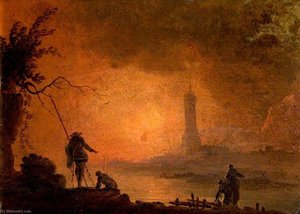
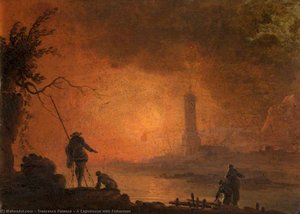
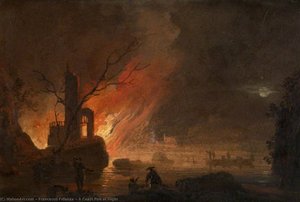
Beyond these grand commissions, Fidanza found his most intimate expression in nocturnal landscapes. He possessed a rare gift for capturing the "blue hour" and the silvered glow of moonlight upon rocky coastlines. These scenes often feature:
- The interplay of shadow: Using deep, velvety tones to create depth and mystery.
- Luminous highlights: Capturing the ethereal shimmer of light on wet stones and breaking surf.
- Atmospheric tension: Evoking the silent, powerful presence of the sea under a nocturnal sky.
Legacy and Artistic Lineage
The artistic spirit of the Fidanza family was one of profound dedication to the landscape genre. Francesco was not an isolated talent; his lineage was steeped in the tradition of Italian painting. His father, Filippio Fidanza, was a trained painter who had studied under Marco Benefial, ensuring that Francesco was born into a world where brushstrokes were a primary language. Even his brother, Gregorio Fidanza, contributed to this rich legacy, finding success by emulating the legendary styles of Claude Lorrain and Salvator Rosa. This familial devotion to the landscape ensured that the family name became synonymous with the evocative portrayal of nature's majesty.
Francesco Fidanza passed away in Milan in 1819, leaving behind a body of work that continues to captivate those drawn to the intersection of observation and emotion. His significance lies in his ability to move beyond mere imitation, using the tools of his predecessors to capture the sublime—that specific, breathtaking feeling of awe in the face of nature's grandeur. Today, his paintings stand as enduring windows into a nineteenth-century sensibility, where every coastal breeze and moonlit wave tells a story of the eternal beauty found within the Italian landscape.