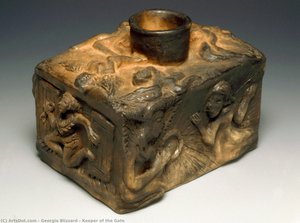
A Visionary in Clay: The Soulful Ceramics of Georgia Blizzard
In the quiet, rolling landscapes of the Appalachian Mountains, a singular artistic voice emerged from the very earth itself. Georgia Blizzard (1919–2002) was not merely a potter; she was a storyteller who used clay as her medium to transcribe the profound complexities of human existence. Born in Saltville, Virginia, Blizzard’s connection to the tactile world began in childhood, long before she ever sought formal instruction. Alongside her sister, Mary, she spent formative years by local creeks, observing the industrious crawfish and using the river's natural clay to fashion miniature fairy castles and small, sun-baked toys. This early, unmediated relationship with the landscape laid the foundation for a career defined by an intimate, almost spiritual dialogue with raw materials.
The trajectory of Blizzard’s life was shaped by the grit and resilience characteristic of the American South during the twentieth century. Her journey through the Great Depression saw her leaving school to participate in the National Youth Administration, and her later years were marked by the heavy labor of munitions factories during World War II and the rhythmic toil of textile mills. These experiences, while physically demanding, contributed to a rich internal tapestry of memory and observation. Even personal hardships, such as a severe illness that necessitated the removal of a lung, served as catalysts for her creative resurgence. It was in the wake of these life-altering shifts that Blizzard returned to the clay, transforming her private struggles into public expressions of beauty and endurance.
The Alchemy of Fire and Heritage
Blizzard’s artistic technique was a masterful blend of ancestral echoes and self-taught experimentation. Claiming both Apache and Irish heritage, she drew upon diverse cultural lineages to inform her aesthetic. Her process often involved the ancient tradition of pit firing, a method she learned from her mother, which allowed for an unpredictable and organic interaction between flame, smoke, and earth. She would meticulously use bark, leaves, or mud to influence the coloring of her pieces, resulting in distinctive brown-and-black surfaces that possessed a rugged, primordial elegance. In later years, she refined this process by using electric kilns to harden her forms before subjecting them to coal kilns for refiring, a dual-stage alchemy that highlighted the natural character of the Appalachian clay.
The subject matter of her work was deeply personal, often serving as a vessel for what she described as her "private demons and sorrows." Her sculptures were rarely mere decorations; they were evocative portraits and narrative plaques. One might encounter:
- Expressive Portraits: Full-figured, hand-shaped faces that captured the likeness of family members or local characters from her memory.
- Spiritual Narratives: Bas-relief carvings depicting biblical themes, such as the sacrifice of Isaac, or scenes of heavenly salvation and damnation.
- Symbolic Totems: Mask-like faces and sculptural vessels that channeled a sense of religious vision and ancestral connection.
Legacy and Artistic Significance
Though she produced a relatively modest volume of work—often fewer than one hundred pots per year—the impact of Georgia Blizzard’s output has been profound. Her work occupies a prestigious space within the realms of Outsider Art and American Folk Art, recognized for its ability to transcend the boundaries of "craft" to reach the level of fine art. Because her pieces were uninfluenced by the formal academic movements of her time, they possess an authentic, raw vitality that resonates with collectors and historians alike.
Today, Blizzard’s legacy is preserved in some of the most esteemed institutions in the United States. Her sculptural vessels and ceramic plaques can be found in the permanent collections of the Smithsonian American Art Museum, the Asheville Art Museum, and the Virginia Museum of Fine Arts. Through her ability to transmute the humble clay of a Virginia creek into profound meditations on memory, faith, and heritage, Georgia Blizzard remains a luminous figure in the history of American ceramic art, reminding us that the most powerful visions often emerge from the simplest of beginnings.