The Architect of Adhesives: The Immersive World of James Lambie
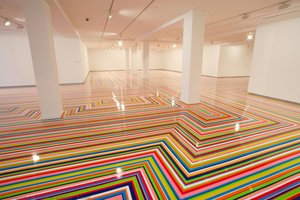
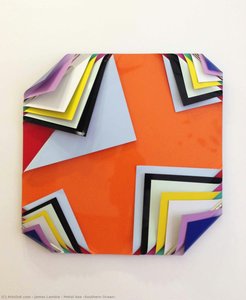
In the vibrant intersection where contemporary sculpture meets the rhythmic pulse of pop culture, the work of James Lambie stands as a transformative force. Born in Glasgow, Scotland, in 1964, Lambie has spent his career redefining the boundaries of installation art by treating the very floor beneath our feet as a canvas for architectural reimagination. His practice is not merely about the placement of objects within a room, but rather an active intervention that reshapes the viewer's perception of space itself. By utilizing the most unassuming of materials—brightly colored vinyl tape, household accessories, and fragments of pop culture—he creates dizzying, hypnotic landscapes that blur the lines between the physical environment and the boundless reaches of the imagination.
Lambie’s artistic journey is deeply rooted in the creative energy of his native Glasgow. A graduate of the prestigious Glasgow School of Art, he honed a technical mastery that would later allow him to execute complex, large-scale geometric feats. However, his sensibilities were shaped by much more than formal academic training; they were forged in the electric atmosphere of the Scottish music scene. As a musician and DJ, and a member of the band The Boy Hairdressers (which evolved into the legendary Teenage Fanclub), Lambie brought a sense of rock n’ roll theatricality to his visual practice. This connection to rhythm, movement, and the "glitter and grit" of club culture is palpable in his work, lending a kinetic spirit to even his most static installations.
Tracing the Lines of Influence and Innovation
The aesthetic language of Lambie’s work draws from a sophisticated lineage of formalist traditions. He finds profound inspiration in the precision of minimalist sculpture and the structural clarity of architectural drawings, citing figures such as Donald Judd and Josef Frank as pivotal influences. This fascination with line and form manifests in his signature "room drawings"—expansive, floor-based sculptures that trace the contours of a building's architecture. These works often utilize repetitive patterns and concentric circuits to create an optical wonderland, echoing the principles of Op Art while maintaining a contemporary, visceral edge.
One cannot discuss Lambie’s impact without acknowledging his meteoric rise within the British art establishment. In 2005, he achieved significant international recognition when he was shortlisted for the prestigious Turner Prize. His installation, Mental Oyster, served as a profound demonstration of his ability to use meticulously arranged vinyl tape to create geometric forms that seem to breathe and undulate. This period marked his transition from a rising talent to a prominent voice in contemporary art, proving that even the most ubiquitous household items could be elevated to the status of high art through sheer visionary intent.
A Symphony of Space and Materiality
At the heart of Lambie’s practice lies a profound belief in the transformative power of simplicity. His ability to take a single, humble material like vinyl tape and weave it into a complex, multidimensional vortex is nothing short of masterful. In landmark works such as Zobop, created for the 2014 Biennale of Sydney, Lambie utilized rhythmic precision to trace the very bones of the Museum of Contemporary Art Australia. The resulting installation was a symphony of light and line, where intersecting stripes radiated from central points, inviting viewers into a state of beautiful disorientation.
Beyond the geometric rigor, there is an emotional resonance in his work that speaks to the ephemeral nature of modern life. By incorporating pop culture objects like posters and album covers, Lambie anchors his abstract forms in the shared cultural memory of his audience. His installations are not static monuments to be viewed from a distance; they are active, breathing environments that demand engagement. Through his unique lens, the mundane becomes extraordinary, and the architectural void is filled with a vibrant, pulsating energy that continues to challenge how we inhabit and understand the world around us.