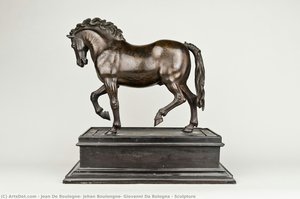
A Life Bridging Worlds: Jean de Boulogne, the Flemish Master in Italy
Jean de Boulogne—known also as Jehan Boulongne and Giovanni da Bologna—stands as a pivotal figure in the transition from High Renaissance classicism to the dynamic complexities of Mannerism. Born in Douai, Flanders, in 1529, his artistic journey was one of geographical and stylistic displacement, ultimately forging a unique voice that resonated throughout Italy and beyond. His story isn’t simply about an artist; it's about the confluence of cultures during a period of intense artistic ferment. Boulogne didn’t merely adopt Italian styles; he synthesized them with his Northern European sensibilities, creating works imbued with both refined elegance and dramatic power.
Early Training and the Roman Awakening
Boulogne’s initial training took place in Antwerp under Jacques Dubroeucq, a sculptor already working within an Italianate framework. This foundation provided him with technical skills but also instilled a nascent appreciation for classical forms. However, it was his move to Rome around 1550 that truly ignited his artistic development. Immersing himself in the world of ancient sculpture and the works of Michelangelo, Boulogne began a rigorous study of anatomy, proportion, and movement. The influence of Hellenistic sculpture is palpable in his early Roman pieces, demonstrating a growing mastery of depicting the human form with unprecedented realism and expressiveness. He absorbed the energy of the Counter-Reformation era, an atmosphere that favored dramatic narratives and emotional intensity—qualities that would become hallmarks of his style.
Florentine Triumph: A Court Sculptor’s Ascendancy
In 1553, Boulogne settled in Florence, a city poised to become the center of his artistic universe. He quickly gained the patronage of Francesco I de' Medici, Grand Duke of Tuscany, and became an integral part of the Medici court. This association proved crucial, providing him with both financial security and access to a wealth of commissions. The Accademia delle Arti del Disegno welcomed him in 1563, solidifying his position within Florence’s artistic elite. Unlike many artists who were encouraged to travel and seek new inspiration, the Medici deliberately kept Boulogne within their sphere of influence, recognizing his exceptional talent and fearing that other courts would attempt to lure him away.
Sculpting Movement and Allegory: Defining a Mannerist Aesthetic
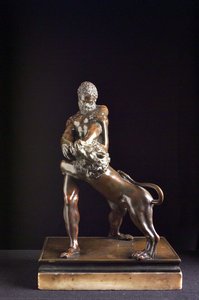
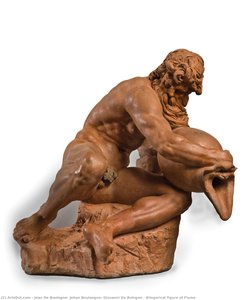
Boulogne’s work is characterized by a remarkable sense of dynamic movement and a sophisticated use of allegory. His sculptures aren't static representations; they capture figures in moments of intense action, often twisting and turning with breathtaking grace. The Fountain of Neptune in Bologna (1563-66) stands as an early testament to his abilities, showcasing a complex composition that rivals Michelangelo’s earlier work. However, Boulogne moved beyond mere imitation, developing a style that emphasized refined surfaces and cool elegance. The Mercury in Flight, with its poised figure supported by Zephyr, exemplifies this aesthetic—a masterful display of balance, tension, and rhetorical gesture. His marble sculpture, the Abduction of a Sabine Woman (1574-82), is particularly noteworthy for being carved from a single block of marble, demonstrating his extraordinary technical skill and compositional ingenuity.
Legacy and Historical Significance
Giambologna’s influence extended far beyond the borders of Italy. His workshop became a prolific center of production, disseminating his style throughout Europe. He established a canon for representing the human form—particularly the female nude—that would be emulated by generations of sculptors. His allegorical works served as powerful tools of political propaganda for the Medici family, solidifying their authority and promoting their ideals. While often categorized as a Mannerist sculptor, Boulogne’s work transcends simple stylistic labels. He synthesized classical principles with Northern European realism, creating a unique artistic language that bridged the gap between the Renaissance and Baroque periods. His sculptures continue to captivate audiences today, not only for their technical brilliance but also for their enduring beauty and emotional resonance.