A Tapestry of Faith and Controversy: The Visionary Art of Jeong Myeong-seok
In the delicate intersection of textile artistry and spiritual devotion lies the work of Jeong Myeong-seok, an artist whose name evokes a complex tapestry of profound creativity and deep-seated controversy. Born in 1945 in the serene landscape of Wolmyeon-dong, South Korea, Jeong—often known by his religious moniker, Joshua Jung—has crafted a legacy that is as much about the meticulous precision of the needle as it is about the turbulent narratives of his personal life. His oeuvre serves as a window into a world where every stitch is an act of prayer and every pattern a vessel for divine symbolism.
The essence of Jeong’s artistic contribution is found in his mastery of embroidery, a medium that demands unparalleled patience and a meditative focus. His work often transcends mere decoration, moving into the realm of visual theology. Through the painstaking application of thread, he explores themes of redemption, grace, and the human condition, frequently utilizing motifs of birds and flowers to represent the blossoming of spiritual truth. These intricate patterns are not merely aesthetic choices; they are a deliberate language designed to invite the viewer into a state of contemplation, mirroring the very devotion that fuels his creative process.
The Convergence of Art and Movement
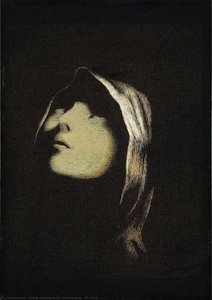
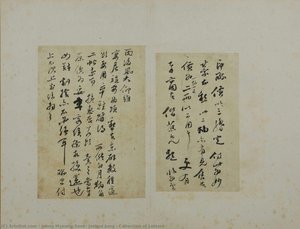
To understand the depth of Jeong’s work, one must navigate the complex landscape of the Providence religious movement, which he founded. As both an artist and a spiritual leader—sometimes referred to as Pastor Joshua Lee—his creative output is inextricably linked to his religious convictions. His art functions as a visual extension of his teachings, where the "Collection of Letters" and works like St. Mary act as storytelling tools for his faith. This connection creates a unique, albeit polarizing, historical significance; his pieces are viewed by some as sacred relics of a personal mission and by others through the lens of the religious movement's broader social impact.
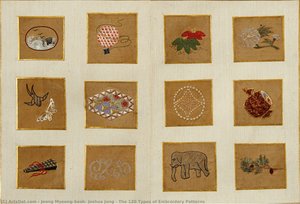
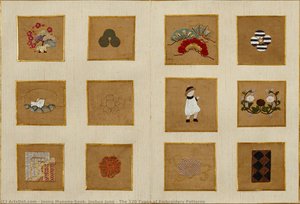
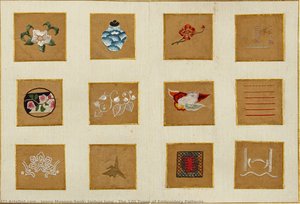
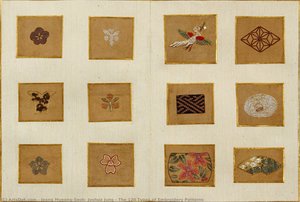
The development of his style is characterized by an increasing complexity in symbolic layering. In masterpieces such as The 120 Types of Embroidery Patterns, one finds a mesmerizing grid of detail that showcases a masterclass in textile artistry. These works demonstrate a profound ability to organize vast amounts of intricate information into a cohesive, breathtaking whole. The use of neutral tones punctuated by vivid color intensities allows the natural beauty of the floral and avian subjects to emerge with a lifelike, almost ethereal quality.
A Legacy Defined by Duality
The historical narrative of Jeong Myeong-seok is undeniably marked by a profound duality. While his technical skill in embroidery has earned him recognition within specialized art circles and museum collections—such as the Hwajeong Museum and Sookmyung Women's University Museum—his life has been shadowed by significant legal challenges. The accusations of sexual assault involving female devotees between 2018 and 2022 have cast a long shadow over his artistic reputation, complicating the way his work is perceived in a contemporary global context.
Despite these turbulent developments, the technical brilliance of his embroidery remains an undeniable facet of South Korean modern textile history. His ability to transform simple thread into complex religious narratives continues to fascinate scholars and collectors alike. As we examine his contributions, we are faced with the challenge of separating the sublime beauty of the craft from the controversial life of its creator, a task that makes the study of Jeong Myeong-seok's art an essential, if unsettling, journey through the power of visual devotion.