A Pioneer of the Ontario Landscape
John Gillespie, a name etched into the foundational layers of Canadian art history, remains an enigmatic yet profoundly influential figure from the mid-19th century. Active primarily between 1841 and 1849, Gillespie emerged during a transformative era for the North American landscape, a time when the rugged beauty of the Ontario wilderness began to be captured through a more deliberate, observational lens. While much of his personal biography remains shrouded in the mists of time, his presence is undeniably felt through his pioneering approach to plein air painting—the practice of stepping out from the safety of the studio to confront the elements directly.
Born in Canada around 1841, Gillespie’s early life and formative influences are largely lost to history, leaving scholars to piece together his artistic identity through the brushstrokes he left behind. What is certain, however, is that he possessed a remarkable sensitivity to the changing light and atmosphere of the Canadian terrain. His work serves as a vital bridge between mere topographical documentation and the emotive, atmospheric qualities that would later define much of the Impressionist movement. In an era when many artists were content with static, studio-bound compositions, Gillespie sought the pulse of the living world.
The Majesty of King Street
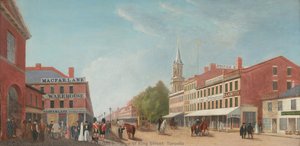
The pinnacle of Gillespie’s short but impactful career is undoubtedly his masterpiece, View of King Street, Toronto. Completed in 1844, this work stands as a monumental achievement in early Canadian art, offering a rare and vivid window into the burgeoning urban landscape of Toronto during its period of rapid industrial expansion. Through this painting, Gillespie does more than simply record the architecture and commerce of a growing city; he captures the very essence of a community in motion.
Technically, the work is a triumph of light and texture. Utilizing oil on canvas, Gillespie employed a method characterized by:
- Subtle Tonal Gradations: A masterful use of color transitions to simulate the soft, shifting qualities of natural daylight.
- Loose Brushwork: An early precursor to Impressionist techniques, where visible strokes contribute to a sense of immediacy and energy.
- Atmospheric Depth: The skillful blending of pigments to create an illusion of vastness, pulling the viewer's eye from the bustling foreground into the hazy distance of the urban horizon.
By positioning himself within the scene, Gillespie achieved a level of realism that transcends mere accuracy. He captured the sensory experience of King Street—the dust, the light, and the palpable sense of progress—making the painting feel less like a frozen moment and more like a breathing memory.
Legacy and Historical Significance
Though his active years were brief, the historical significance of John Gillespie cannot be overstated. He was a true pioneer of the Ontario landscape, helping to establish a tradition of observing the Canadian environment with both scientific precision and artistic soul. His commitment to capturing the fleeting moments of light and atmosphere laid the groundwork for future generations of Canadian landscape painters who would eventually find international acclaim.
Today, Gillespie’s work remains a precious artifact of 19th-century North American life. He stands as a testament to the power of the artist as an observer, reminding us that the most profound beauty is often found in the meticulous study of our evolving world. His ability to transform a bustling streetscape into a poetic meditation on light and time ensures his enduring place in the pantheon of Canadian art pioneers.