A Visionary of the Nazarene Spirit
Born in the quiet, picturesque landscape of Kratzau—known today as Chrastava—on February 9th, 1800, Joseph Ritter von Führich emerged as a profound voice within the Nazarene movement. His artistic soul was shaped by the rustic, pious atmosphere of his Bohemian childhood, where the simple, evocative depictions found in wayside chapels left an indelible mark upon his young mind. This early encounter with sacred imagery instilled in him a lifelong devotion to biblical narratives, rendered not through grand spectacle, but through a meticulous and spiritual clarity. As he matured, his work became a bridge between the ancient traditions of Christian art and the burgeoning Romantic sensibilities of the nineteenth century.
Führich’s formal education began under the guidance of Joseph Bergler at the Prague Academy, where he mastered the essential foundations of draughtsmanship. However, it was his deep immersion in the works of Albrecht Dürer and the detailed illustrations of Peter von Cornelius that truly ignited his creative passion. These influences provided a blueprint for his approach to line and narrative, leading him toward a style that favored precision over flamboyant emotion. In 1826, seeking further refinement, he embarked on a transformative pilgrimage to Rome. This journey allowed him to commune directly with the legacies of Raphael and Michelangelo, absorbing their mastery of composition and integrating classical ideals into his uniquely Nazarene aesthetic.
The Art of Spiritual Contemplation
What distinguished Führich from many of his Romantic contemporaries was his deliberate rejection of dramatic excess. While others sought to overwhelm the viewer with sweeping landscapes or turbulent emotions, Führich championed a restrained palette and precise outlines designed to convey eternal spiritual truths. His technique was characterized by an extraordinary level of detail, particularly in his draughtsmanship, which earned him widespread acclaim. He believed that art should serve as a vessel for moral significance, often focusing on scriptural episodes that could be understood by the common person, much like the roadside paintings of his youth.
His oeuvre is marked by several key artistic characteristics:
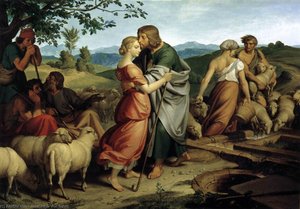
- Sacred Narratives: An almost exclusive focus on religious and biblical themes, such as the poignant encounter between Jacob and Rachel.
- Nazarene Precision: A commitment to clear contours and a sense of stillness that invites meditation rather than distraction.
- Masterful Draughtsmanship: A profound skill in pen and ink that allowed him to capture the delicate nuances of human expression and natural detail.
- Classical Integration: The seamless blending of Renaissance-inspired composition with a nineteenth-century Romantic sensibility.
Legacy and Institutional Eminence
As his career progressed, Führich’s influence extended far beyond the canvas and into the very heart of European art institutions. His reputation as a scholar and educator led to several prestigious appointments that cemented his historical significance. He served as the director of the Prague Academy in 1854 and later became a professor at the Vienna Academy in 1865. Perhaps most notably, his tenure as the director of the Belvedere Gallery in 1871 allowed him to shape the preservation and presentation of significant Austrian art. By the time he reached the position of rector of the academy in 1874, he had become a pillar of the academic art world.
The legacy of Joseph Ritter von Führich remains etched in the history of the Nazarene movement. He succeeded in reviving the models of earlier ages, creating works that felt both ancient and immediate. His ability to translate complex theological concepts into accessible, beautiful imagery ensured that his sacred subjects found a place not only in prestigious galleries like the Belvedere but also in the hearts of those who sought solace in the quiet beauty of his vision. Today, he is remembered as an artist who looked backward to the masters of the past to find a way forward for the spiritual expression of his time.