A Legacy Forged in Metal and Light
The story of Karl Stirner is one of profound transformation, a journey that began in the quiet forests of Germany and found its ultimate expression in the industrial strength of American metalwork. Born on November 14, 1923, in Bad Wildbad, Germany, Stirner was the youngest of five children born into a lineage of jewelers and precious-metalsmiths. This early immersion in the delicate art of metallurgy planted the seeds for a lifetime of sculptural mastery. When his family immigrated to Philadelphia in 1927, they brought with them a tradition of craftsmanship that would later merge with Stirner’s fascination with the natural world. As a young boy, he was an avid naturalist, finding infinite wonder in the intricate patterns of minerals, crystals, and every living creature he encountered—a curiosity that would eventually breathe life into his rigid steel and bronze forms.
Stirner’s path to artistic prominence was anything but linear, shaped by the turbulent winds of the twentieth century. His early years were marked by a drive for technical precision; he studied mechanical engineering at the Drexel Institute of Art and worked as an industrial designer. This period of rigorous training in mechanics provided him with the essential vocabulary of structure and balance that would define his later sculptures. However, his life took a dramatic turn during World War II, when he served in the U.S. Army within the combat zones of New Guinea and the Philippine Islands. These experiences, though harrowing, perhaps deepened his connection to the raw, elemental forces of nature that he so frequently sought to capture in his art.
The Intersection of Engineering and Expression
Returning to a civilian life in Philadelphia, Stirner began to bridge the gap between the precision of an engineer and the soul of an artist. He operated experimental machine shops and developed unique mechanical devices, yet his heart remained tethered to the aesthetic possibilities of metal. His work became a dialogue between the industrial and the organic. Utilizing tools like grinders, drills, and torches, he transformed cold, heavy materials into fluid, evocative compositions. His mastery of metalwork allowed him to manipulate space and light, creating pieces that seemed to defy the very weight of their medium.
As an educator, Stirner left an indelible mark on the American art landscape. Through his professorships at prestigious institutions such as the Tyler School of Art, Temple University, Moore College of Art, and Swarthmore College, he mentored generations of artists, sharing his deep knowledge of sculpture and painting. His influence extended far beyond the classroom; he was a vital force in the revitalization of the arts scene in Easton, Pennsylvania. By converting a former industrial warehouse into the Easton Arts Building, he created a sanctuary for creativity that served as his home, studio, and gallery, effectively turning a decaying urban space into a thriving cultural hub.
A Visionary Presence in Contemporary Art
The significance of Karl Stirner’s oeuvre lies in its ability to command attention through both scale and subtlety. His sculptures have graced some of the most renowned institutions in the world, including:
- The Museum of Modern Art (MoMA), New York
- The Philadelphia Museum of Art
- The Corcoran Gallery of Art, Washington, DC
- The Pennsylvania Academy of the Fine Arts
- The La Jolla Museum of Contemporary Art
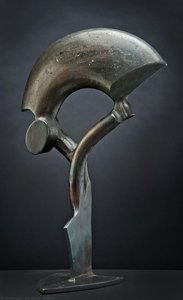
Stirner’s work is characterized by a bold use of color and an ability to evoke the essence of landscapes through abstract forms. His sculptures do not merely sit in space; they interact with it, capturing the movement of light and the rhythm of the surrounding environment. This connection to place is perhaps most poignantly realized in the Karl Stirner Arts Trail, a tribute to his lifelong commitment to community and public art. Through this trail, his metallic visions become part of the very fabric of the landscape, ensuring that his legacy as a pioneer of color and imagination remains an enduring part of the American artistic spirit.