The Master of Flemish Mountainscapes
In the golden age of the Flemish Baroque, amidst the bustling artistic fervor of Antwerp, there lived a painter whose brush possessed the power to conjure entire worlds of stone and sky. Kerstiaen de Keuninck, born in Kortrijk around 1560, was far more than a mere chronicler of scenery; he was an architect of atmosphere. While history often reserves its brightest spotlights for titans like Rubens or Rembrandt, De Keuninck carved out a profound niche for himself through his ability to marry the rugged, untamed majesty of mountain landscapes with the delicate, spiritual weight of biblical and mythological narratives. His life, though partially obscured by the mists of time, reflects the very essence of the Antwerp Guild of St. Luke, where he was recognized as a master in 1580, establishing himself as a cornerstone of the local artistic community.
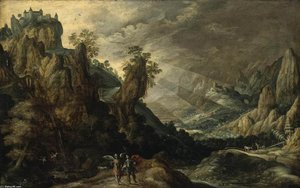
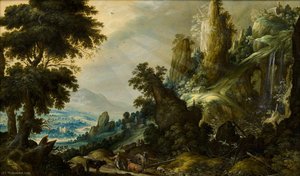
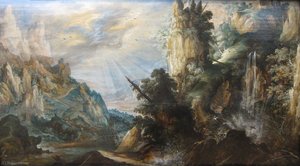
To gaze upon a De Keuninck canvas is to embark on a journey through a landscape that feels both ancient and immediate. His work is defined by a breathtaking sense of scale, where towering peaks and cascading waterfalls serve as more than just geological features. Instead, they act as emotional resonators. In masterpieces such as Landscape with Tobias and the Angel, the artist utilizes the dramatic topography to frame divine intervention. The rugged terrain, often characterized by turbulent skies and deep, shadowed valleys, provides a stark, earthly contrast to the ethereal presence of the celestial figures. This interplay between the monumental scale of nature and the intimate drama of human—or divine—interaction is what gives his oeuvre such enduring emotional resonance.
Technique, Symbolism, and Legacy
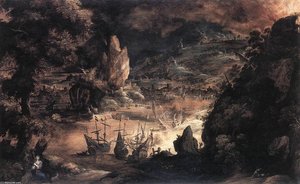
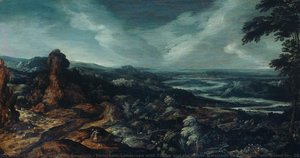
The technical prowess of De Keuninck lies in his masterful command of chiaroscuro. He understood that light is not merely a tool for visibility but a medium for storytelling. By orchestrating the dramatic interplay between brilliant highlights and profound shadows, he imbued his mountain vistas with a palpable sense of depth and moisture, as if one could feel the spray from a distant waterfall or the chill of a passing storm. His meticulous attention to detail allowed him to render the textures of rock, foliage, and water with an accuracy that grounded his more allegorical subjects in a believable, tactile reality.
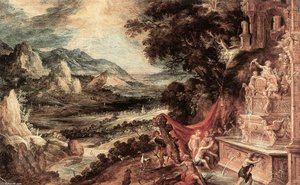
Beyond the purely aesthetic, De Keuninck’s work served as a vessel for the moral and spiritual inquiries of his era. He frequently turned to classical mythology and biblical lore to weave complex tapestries of meaning. In works like Landscape with Actaeon and Diana, he utilized the dramatic setting to explore themes of hubris and divine retribution, using the landscape itself to mirror the tension of the mythological huntress's confrontation. This ability to infuse landscape painting with intellectual and moral weight helped elevate the genre from simple topographical representation to a sophisticated form of high art.
The legacy of Kerstiaen de Keuninck extends far beyond his own finished canvases, reaching into the very lineage of Flemish art through his role as a dedicated pedagogue. As a teacher, he nurtured the talents of future masters, including Engelbert Ergo and Carel van Ferrara, ensuring that his fascination with dramatic light and monumental landscapes would influence subsequent generations. His contribution to the Antwerp school remains a vital chapter in the history of the Baroque, reminding us that the true power of art often lies in its ability to find the divine within the wild, untamed corners of the natural world.