The Echoes of Displacement and Heritage
Lidia Giuliana Bastianich’s artistic consciousness was forged in the crucible of profound transition. Born in Naples in 1970, her early life was shadowed by the historical weight of the Istrian–Dalmatian exodus, a period of family displacement that instilled in her a lifelong preoccupation with themes of resilience and adaptation. This sense of movement and loss finds its way into her sculptures, where the permanence of material meets the ephemeral nature of memory. Her connection to the earth was further nurtured by the influence of her grandmother, Rosa, whose farm-to-table philosophy emphasized a deep respect for natural ingredients and simplicity—a principle that Bastianich translates into her sculptural language through the use of organic, reclaimed textures.Her childhood in the vibrant cultural landscape of Southern Italy fostered a fascination with traditional craftsmanship. This heritage, blended with the personal history of her family's movement, allows her work to act as a bridge between the ancestral past and the contemporary moment, creating a sense of continuity amidst the chaos of change.
From Academic Tradition to Abstract Innovation
Her formal journey led her to the prestigious Accademia di Belle Arti di Napoli, where she mastered the technical rigors of classical sculpture before embarking on a radical departure from representational forms. Bastianich began to move away from the literal depiction of the human figure, instead seeking to capture its essence through geometric abstraction and minimalist principles. This grounding in academic tradition provided her with the tools to transcend stylistic boundaries while maintaining an unwavering focus on core artistic concepts.By integrating unconventional materials such as reclaimed wood and weathered metal, she creates a dialogue between the industrial and the organic. Her work does not merely occupy space; it redefines it, utilizing the interplay of light and shadow to challenge the viewer's perception of what is solid and what is void. Through this method, she transforms the physical weight of her materials into something much more ethereal and conceptual.
The Architecture of Emotion
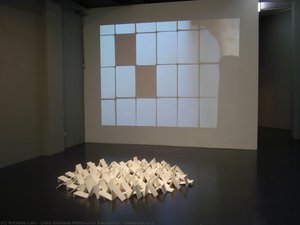
In her most acclaimed installations, such as Deflector n°1, Bastianich transforms architectural environments into immersive, contemplative landscapes. Her sculptures act as catalysts for a deeper exploration of the relationship between the human form and the surrounding space. Through meticulously crafted environments, she invites the observer to confront challenging questions regarding perception and existence. The following elements define her sculptural impact:- Materiality: The use of reclaimed wood and metal to evoke history, texture, and the passage of time.
- Spatial Interplay: A focus on how light, shadow, and structure interact within a room to create atmosphere.
- Conceptual Depth: Moving beyond the visual to provoke emotional and philosophical inquiry into the human condition.