The Genesis of a Versatile Visionary
Lumen Martin Winter was an artist whose soul seemed carved from the very landscapes he traversed during his formative years. Born in 1908 amidst the shifting horizons of Illinois, his early life was a tapestry of movement and observation, shaped by the rugged traces of the Santa Fe Trail and the industrious spirit of the American Midwest. Before he became a master of monumental scale, Winter honed his eye as a young illustrator and cartoonist, finding rhythm in the lines of newspapers and magazines. This early immersion in visual storytelling provided the foundation for a career that would eventually transcend the boundaries of mere decoration, moving instead toward a profound engagement with the human condition. His education at prestigious institutions like the
Cleveland School of
Art and the
National Academy of Design infused his natural observational skills with a classical rigor, allowing him to bridge the gap between the raw energy of Regionalism and the sophisticated nuances of Modernism.
A Symphony of Stone and Pigment
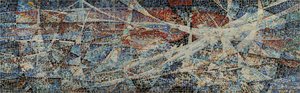
To encounter the work of Winter is to witness a refusal to be confined by the limitations of a single medium. He possessed a rare, almost alchemical ability to manipulate diverse materials—from the fluid grace of watercolor and the rich depth of oil paint to the enduring strength of marble and wood. He was particularly celebrated for his groundbreaking contributions to mosaic art, where he mastered the delicate dance of
tesserae and grout to create surfaces that seemed to breathe with light. In works such as the breathtaking mosaics of the
United States Air Force Academy Cadet Chapel, Winter achieved a luminous effect that transformed cold stone into a shimmering narrative of biblical grandeur. His technique was never merely about application; it was about the creation of texture and atmosphere, ensuring that every fragment of color served a larger, spiritual purpose. This commitment to versatility allowed him to maintain an artistic ideology of resistance, forever evading the trap of a singular, predictable style.
The Architecture of Public Narrative
Winter’s true legacy lies in his ability to weave art into the very fabric of civic and social life. He did not create art for the isolation of galleries, but for the shared spaces of humanity, leaving an indelible mark on the American landscape through over fifty significant public projects. His work acted as a visual bridge between grand historical narratives and the contemporary pulse of society. Some of his most enduring contributions include:
- The monumental murals within the AFL-CIO Building in Washington, D.C., which explored the powerful themes of labor solidarity and social justice.
- The intricate and storytelling mosaics at the United Nations General Assembly Building
- The energetic and colorful Voice of the Bell, a project that captured the vibrant spirit of public commemoration.
- His creative contribution to the official insignia for NASA’s Apollo Lunar Landing Project, marking his reach even into the frontiers of space exploration.
Through these works, Winter functioned as a storyteller for the masses, utilizing the permanence of sculpture and the brilliance of mosaic to inspire contemplation and unity. His life's work remains a testament to the power of public art to reflect our highest aspirations and most profound shared histories.