A Legacy of Faith and Fortitude: The Life of Mahlon Van Horne
Mahlon Van Horne (1840–1910) was a man whose life unfolded as a profound tapestry of spiritual devotion, political pioneering, and diplomatic grace. Born in Princeton, New Jersey, his journey was one of constant ascent, moving through the corridors of religious leadership and the halls of legislative power with an unwavering commitment to justice. As a scholar of classical languages and theology at the Ashmun Collegiate Institute—now known as the historic Lincoln University—Van Horne prepared himself for a life that would bridge the gap between the pulpit and the political stage. His early years were defined by a rigorous intellectual pursuit, laying the foundation for a man who would eventually command respect across both sacred and secular landscapes.
His spiritual calling found its home in Newport, Rhode Island, where he served as the pastor of the Union Colored Congregational Church from 1869 to 1898. Under his stewardship, the congregation did more than just grow in number; it became a sanctuary of resilience. Van Horne oversaw the rebuilding of the church after a devastating fire, symbolizing a broader theme of reconstruction and hope that would characterize much of his life’s work. In the quiet strength of his ministry, he cultivated a deep connection to his community, earning him the reputation as Newport's most beloved minister by the late nineteenth century.
Breaking Barriers in the Political Arena
The transition from the pulpit to the legislature was not merely a change in occupation, but an extension of Van Horne’s moral crusade. In 1885, he achieved a milestone that would echo through the history of Rhode Island: he became the first African American elected to the state legislature. Serving three consecutive terms in the General Assembly, his presence in the halls of power was a radical act of visibility and a testament to his political acumen. He did not enter politics for prestige, but as a vessel for legislative change, most notably spearheading the passage of a crucial Civil Rights bill in 1885.
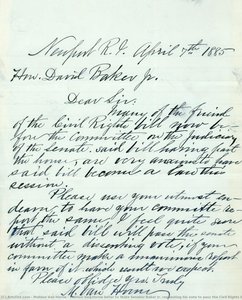
This period of his life was marked by a relentless pursuit of constitutional protections. His correspondence from this era, such as his poignant letter to State Senator Baker Jr., reveals a man who understood the delicate art of persuasion and the necessity of persistent advocacy. Through his legislative achievements, Van Horne helped dismantle the invisible barriers of his time, ensuring that the promise of equality was not just a spoken ideal but a codified reality for the marginalized citizens of Rhode Island.
Diplomacy and the Global Horizon
As his influence expanded beyond the borders of New England, Van Horne’s life took on an international dimension. In 1896, President William McKinley recognized his exceptional character and leadership by appointing him as the United States Consul to the Danish West Indies at Saint Thomas. This appointment transformed the Rhode Island minister into a diplomat, tasking him with representing American interests in the vibrant, complex landscape of the Caribbean. Serving in this capacity until 1903, he navigated the intricacies of international relations with the same poise and integrity that had defined his domestic service.
The historical significance of Mahlon Van Horne lies in his ability to transcend the limitations imposed upon him by the era. He was a man of many worlds:
- A Spiritual Anchor: Providing leadership and stability to the Black community in Rhode Island through decades of ministry.
- A Legislative Trailblazer: Breaking racial barriers in the Rhode Island General Assembly and championing civil rights legislation.
- A Global Representative: Serving as a bridge between nations as a United States Consul in the Danish West Indies.
His life remains a powerful narrative of how personal conviction can reshape the political and social fabric of a nation, leaving behind a legacy that continues to inspire admiration for its courage and enduring impact.