The Painter of Domestic Bliss: The Life and Legacy of Memmo di Filippuccio
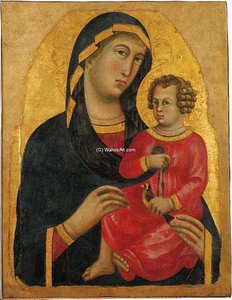
In the golden light of the early fourteenth century, amidst the rising humanism of Tuscany, the name Memmo di Filippuccio emerged as a vital voice in the Sienese school. Born around 1263 into a family deeply rooted in the prestigious goldsmithing traditions of Siena, Memmo’s artistic sensibilities were forged through the meticulous precision of metalwork and the delicate artistry of his father, Filippuccio. This early immersion in the fine details of craftsmanship would later define his approach to painting, allowing him to capture the textures of fabric, the warmth of skin, and the quiet intimacy of human connection with an unparalleled sensitivity that set him apart from the more rigid iconographic traditions of his era.
While much of the biographical record regarding Memmo remains shrouded in the fragmented archives of the Middle Ages, his presence in the historical landscape is undeniably profound. By 1303, municipal records place him actively engaged in significant civic commissions, most notably within the Town Hall of San Gimignano. It was here, in the mayoral chamber, that Memmo would leave his most enduring mark upon the world. His frescoes do not merely serve as decoration; they act as windows into a lost era, portraying scenes of everyday life with a psychological depth and a daring realism that whispered of the changing intellectual tides of the time.
A Master of Intimacy and Human Connection
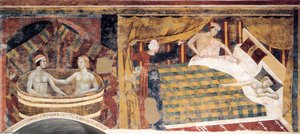
The true genius of Memmo di Filippuccio lies in his ability to elevate the mundane to the level of the monumental. His most celebrated works, often referred to as his scenes of domestic bliss, break away from the purely divine subjects common in Sienese art to explore the profound beauty found in human relationships. One of his most evocative compositions depicts a husband and wife sharing a bath within a large tub, a scene framed by a striped screen and attended by a maid. This work, alongside another depicting the tender moments of a bedroom scene, showcases a remarkable bravery; it captures the vulnerability and warmth of domestic life with a level of naturalism that was strikingly progressive for the early 1300s.
Through these frescoes, Memmo achieved several artistic milestones:
- The Humanization of Art: He moved beyond static religious figures to portray characters with palpable emotion and physical presence.
- Narrative Realism: His ability to use domestic settings—the fold of a curtain, the placement of a maid, the steam of a bath—to tell stories of human intimacy.
- Technique and Texture: Utilizing his background in goldsmithing to bring a refined, decorative elegance to the fresco medium, blending Sienese grace with a new, observational truth.
A Dynasty of Sienese Excellence
Memmo di Filippuccio was not merely an isolated talent but the patriarch of a formidable artistic lineage that would shape the trajectory of Italian painting. His influence flowed directly into the next generation through his sons, Lippo Memmi and Federico Memmi, both of whom became accomplished painters who carried forward the stylistic elegance and technical precision of their father. The family’s reach was further solidified through a strategic and artistic marriage to Isabella Martini, the daughter of the legendary Simone Martini. This union forged an alliance between two of the most influential artistic families in Siena, intertwining Memmo’s penchant for intimate realism with the sophisticated, lyrical style that would define the Sienese Gothic period.
As the transition from the formal structures of the Gothic era toward a more human-centric Renaissance began to take shape, Memmo di Filippuccio stood at the threshold. His work remains a testament to a moment in history when art began to look away from the heavens and toward the hearth, finding the sacred within the simple, beautiful rhythms of daily life. Today, his legacy lives on through the vibrant colors of the San Gimignano frescoes, reminding us that the most profound truths are often found in the quietest moments of human existence.