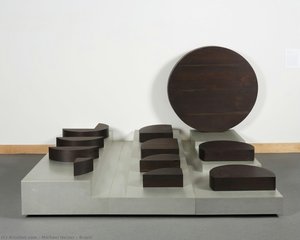
The Architect of Absence: The Visionary World of Michael Heizer
To understand the monumental scale of Michael Heizer, one must first look to the ancient shadows of the Americas. Born in Berkeley, California, on August 4, 1944, Heizer’s artistic consciousness was shaped not by galleries, but by the profound archaeological landscapes he traversed during childhood expeditions with his father, Robert Heizer, a renowned anthropologist. Witnessing the remnants of great civilizations in Central and South America instilled in him a lifelong fascination with monumental architecture and the haunting dialogue between human intervention and the primordial natural world. This early exposure to the grandeur of stone and the weight of history would eventually become the bedrock of his artistic identity, leading him to move beyond the canvas and into the very crust of the earth itself.
Heizer’s journey toward becoming a pioneer of the Earthworks movement began in the vibrant, yet restrictive, art scene of New York City in the mid-1960s. Before he was moving mountains, he was manipulating surfaces. His early explorations involved displacement paintings—geometric canvases executed with PVA latex that played with the tension between positive and negative space. In works such as Trapezoid Painting and Track Painting, Heizer utilized hard-edged forms to emphasize the perimeters of raw canvases, treating the white interiors as voids or negative spaces. These early experiments were far more than mere minimalist exercises; they were conceptual rehearsals for the massive excavations that would define his career, establishing a foundational aesthetic where presence is defined by absence.
Carving the Desert: The Emergence of Land Art
The true metamorphosis of Heizer’s practice occurred in 1967, when he abandoned the urban confines of New York for the expansive, sun-drenched deserts of California and Nevada. This transition marked his definitive entry into the vanguard of Land Art. Seeking a medium that could match the scale of his ambitions, Heizer turned to the landscape as both his canvas and his clay. His seminal contribution began with North, East, South, West, a series of precisely positioned holes dug into the Sierra Nevada landscape—a profound act of subtraction that challenged the traditional notion of sculpture as an additive process.
Unlike traditional sculptors who build upward, Heizer’s genius lies in his ability to create through removal. By utilizing heavy earth-moving equipment, he began to redefine sculpture in terms of mass, gesture, and geological process. His most iconic achievement, Double Negative, stands as a testament to this philosophy. By excavating massive trenches into the Mormon Mesa, Heizer created a work that exists primarily as a void, a monumental scar on the landscape that invites the viewer to contemplate the sheer power of emptiness. This mastery of the negative form—the idea that what is taken away is just as significant as what remains—has become his most enduring artistic signature.
A Legacy Written in Stone and Earth
The historical significance of Michael Heizer’s work lies in his ability to transcend the boundaries of the museum, creating site-specific installations that are inseparable from their environments. His later projects have reached even more staggering proportions, such as Levitated Mass, where a 340-ton granite megalith was perched over a long, constructed slot at the LA County Museum of Art. This feat of engineering and artistry perfectly encapsulates his career-long obsession with the interplay between immense weight and precarious balance, between the man-made and the geological.
Today, Heizer’s influence persists as a cornerstone of 20th-century environmental art. His work continues to provoke deep emotional responses, forcing us to confront our own scale within the vastness of time and space. Through his monumental interventions, he has achieved several lasting milestones:
- Redefinition of Sculpture: Moving the medium from the pedestal to the planetary scale.
- Mastery of Negative Space: Using excavation as a primary tool for artistic expression.
- Integration of Landscape: Creating works that function as permanent, evolving parts of the Earth's topography.
- Conceptual Depth: Bridging the gap between ancient archaeological awe and modern minimalist precision.
As he continues to work in Hiko, Nevada, and New York City, Heizer remains a singular figure in art history—a sculptor who does not merely decorate the world, but fundamentally reconfigures our perception of it.