The Visionary of the Shaped Canvas: The Life and Legacy of Neil Williams
In the vibrant, experimental landscape of mid-century abstraction, few figures possessed the radical ingenuity of Neil Williams. Born in 1934 in Bluff, Utah, Williams was an artist whose very approach to the medium challenged the traditional boundaries of what a painting could be. His journey was one of profound movement—from the rugged landscapes of his American youth through the rigorous training at the San Francisco Art Institute, to the electric, avant-garde atmosphere of New York City in 1959. This migration placed him at the epicenter of a revolution, where he would eventually emerge as a pioneer of the "shaped canvas," a technique that transformed the flat plane into a sculptural, multidimensional experience.
Williams’s early artistic sensibilities were deeply informed by the haunting textures of Surrealism and the quiet, meditative precision of Expressionism. He drew inspiration from masters such as Giorgio Morandi and Wilhelm Künstler, yet he possessed an irrepressible urge to move beyond mere representation. As his career progressed through the 1960s, he began to distance himself from established stylistic conventions, seeking instead a way to marry physical form with psychological depth. This led to his most celebrated innovation: the construction of canvases that broke away from the rectangular tyranny of tradition. By applying dried skins of paint to sheets of glass and manipulating the very edges of his supports, Williams created works that felt less like windows into another world and as much like physical artifacts of a fractured reality.
A Dialogue Between Form and Emotion
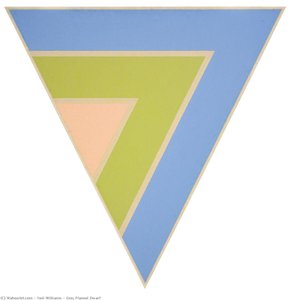
While many of his contemporaries in the American art scene were gravitating toward the austere, geometric rigidity of Minimalism, Williams carved out a unique space for lyrical abstraction. He resisted the coldness of pure geometry, choosing instead to infuse his compositions with an emotive resonance that spoke to themes of isolation, decay, and the human condition. His work often functioned as a delicate balance between the hard-edge precision of geometric shapes and a profound, almost existential, atmospheric depth. In pieces such as "Grey Flannel Dwarf," one can witness this tension—a striking composition of overlapping triangles that uses vibrant color to create a sense of contemplative equilibrium.
The technical mastery required for his shaped canvases was nothing short of extraordinary. His process involved a complex layering of pigment and material, creating textured surfaces that invited the viewer to contemplate the interplay between light and matter. This fascination with the "skin" of the painting mirrored his broader preoccupation with the confrontation between human consciousness and an indifferent, often overwhelming, cosmos. Through his work, the canvas became a site of struggle, where the deliberate fragmentation of color and form served as a metaphor for the complexities of modern existence.
Recognition and Historical Significance
The trajectory of Williams’s career was marked by significant milestones that cemented his importance within the international art community. His presence in the New York art scene was formidable, with exhibitions at prestigious venues such as the Green Gallery, the André Emmerich Gallery, and the Dwan Gallery. One of his most defining moments occurred in 1966, when his work was featured in the influential Systemic Painting exhibition at the Solomon R. Guggenheim Museum, curated by the legendary Lawrence Alloway. This exhibition placed him alongside the giants of geometric abstraction, highlighting his role in the evolution of hard-edge and color field painting.
Beyond the gallery walls, Williams was a dedicated educator, sharing his profound insights as a faculty member at the School of Visual Arts during the late 1970s and early 1980s. His contributions to the art world were recognized with prestigious honors, including a Guggenheim Fellowship in 1968, an accolade that underscored his status as a leading voice in contemporary abstraction. Though his life was tragically cut short in 1988, his legacy persists through the enduring impact of his formal innovations. He remains a singular figure whose work continues to bridge the gap between the structural rigor of modernism and the profound, unyielding depths of human emotion.