A Singular Voice Rooted in Tradition
The artistic journey of Pala Pothupitiye is a remarkable tale, born into the vibrant tapestry of Sri Lanka's Southern Tamil heritage and propelled forward by an unwavering dedication to contemporary art. Raised amidst a family steeped in the traditions of craft-artists and ritualists, his formative years instilled within him a profound appreciation for ancestral motifs and techniques that would later permeate his distinctive visual language. This upbringing is far more than merely biographical; it serves as the very foundation for understanding the core essence of his creative output, providing a deep well of cultural memory from which he draws inspiration.
His formal evolution began at the Visual and Performance Art University in Colombo, Sri Lanka, where he pursued his Bachelor of Fine Arts degree. This academic milestone marked a pivotal step toward formalizing his artistic vision, allowing him to bridge the gap between inherited tradition and modern conceptualism. The legacy of his family’s craft traditions—particularly the intricate beauty of batik prints and the grandeur of ceremonial costumes—undeniably shaped his initial explorations into textile art. These influences are not simply relics of his past; they actively inform his compositional choices and textural considerations in every piece he creates.
The Dialogue Between Past and Present
Pothupitiye’s artistic practice centers around a compelling dialogue between the past and the present, skillfully blending traditional Sri Lankan aesthetics with innovative materials and modern conceptual frameworks. He does not aim to merely replicate tradition but rather to reinterpret it—to distill its spirit into forms that resonate powerfully within the context of contemporary art discourse. This approach distinguishes him from many artists who prioritize stylistic imitation over a genuine engagement with cultural heritage.
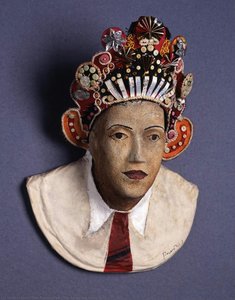
In his work, one often finds a fascinating tension between the sacred and the discarded. A profound example can be seen in his exploration of the Candy Dance, a famous traditional dance in Sri Lanka. In an act that feels like a poignant homage to his own father, who was a Candy dancer, the artist decorates the bust of a dancer with excessive ornamentation. However, there is a brilliant irony in his choice of medium; he utilizes cheap plastic and discarded materials to achieve this splendor. Through this, he suggests that the contemporary industrial materials and neon lights of our urban cities possess a common allure with traditional culture, creating a bridge between the ancient ritual and the modern street.
Mastery of Texture and Symbolism
The technical brilliance of Pothupitiye lies in his ability to elevate humble or unconventional materials into sophisticated visual statements. His work often showcases a meticulous attention to layered textures and symbolic design, creating a sensory experience that invites deep contemplation. This is beautifully exemplified in notable works such as “The Ancestral Dress 2”, which serves as a testament to his ability to fuse diverse influences.
In this piece, he combines Indonesian artistic sensibilities with modern textile techniques, presenting a meticulously crafted headdress adorned with symbolic designs. The result is a work that feels both ancient and avant-garde, demonstrating his mastery in the following areas:
- Textile Innovation: Reimagining traditional batik and ceremonial textures through contemporary lenses.
- Material Subversion: Using industrial plastics and discarded elements to mimic the prestige of ritualistic adornment.
- Cultural Synthesis: Blending Southern Sri Lankan heritage with broader Southeast Asian artistic sensibilities.
Ultimately, Pala Pothupitiye stands as a significant figure in contemporary Sri Lankan art, an artist who refuses to let tradition become a static museum piece, instead choosing to breathe new, vibrant life into it through the lens of the modern world.