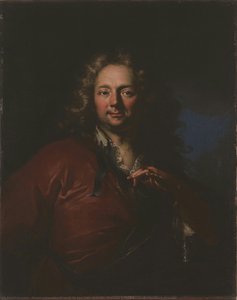
The Bohemian Soul: The Life and Legacy of Peter Johannes Brandl
In the heart of the late Baroque era, amidst the winding streets of Prague, a painter emerged whose brush captured the very essence of drama, tension, and human emotion. Peter Johannes Brandl, also known as Jan Petr Brandl, was not merely an artist but a force of nature within the Bohemian landscape. Born in 1668 to a Czech-German family, his early years were steeped in a cultural duality that would later inform the rich, multifaceted textures of his work. The son of a tailor, Brandl’s path was far from predestined for the heights of artistic fame, yet his destiny was forged in the shadows of the great galleries of Prague. His childhood, spent gazing upon the masterpieces housed in the Nostic Palace, planted the seeds of an insatiable aesthetic hunger that would eventually lead him to become the most prominent Baroque painter in Bohemia.
The trajectory of Brandl’s talent was irrevocably shaped by his apprenticeship under the court painter Kristián Schröder. This formative period served as a profound immersion into the masters of the past; through Schröder, the young Brandl was introduced to the grandeur of the Italian Renaissance and the technical prowess of the Flemish and Dutch traditions. He studied the light of Titian and Tintoretto, the coloristic brilliance of Veronese, and the muscular energy of Rubens. This diverse education allowed him to synthesize a unique style—one that could pivot from the monumental scale of religious altarpieces to the intimate, psychological depth of portraiture. While his personal life was often marked by a certain bohemian turbulence, including financial struggles and a reputation for living on the edge of social propriety, his artistic output remained a constant beacon of technical brilliance.
A Master of Light and Shadow
To encounter a painting by Brandl is to witness a theatrical performance captured in pigment. He was a master of chiaroscuro, utilizing the dramatic interplay between deep, swallowing shadows and piercing highlights to direct the viewer's eye and evoke profound spiritual or emotional responses. This technique, reminiscent of the great Caravaggio, lent his religious compositions an almost palpable sense of presence. His works, such as the celebrated Simeon with the Baby Jesus, are characterized by a powerful, passionate movement of color and a distinct tenderness that softens the intensity of his more dramatic scenes.
Beyond the manipulation of light, Brandl’s technical repertoire was defined by several key elements:
- Impasto Technique: The thick, tactile application of paint allowed him to create physical texture, giving life to the folds of fabric and the weathered skin of his subjects.
- Genre Painting: Unlike many of his contemporaries who focused solely on the divine, Brandl ventured into the realm of everyday life, drawing inspiration from Netherlandish masters like Gerrit van Honthorst to depict scenes of human interaction and character studies.
- Portraiture: His portraits often leaned toward a Netherlandish sensibility, demonstrating an intimate knowledge of artists like Nicolas Maes, capturing the dignity and psychological complexity of his sitters.
Historical Significance and Enduring Spirit
The historical importance of Peter Johannes Brandl lies in his ability to localize the grand European Baroque movement within the specific cultural context of Bohemia. He was a bridge between the classical traditions of the Renaissance and the emotive, energetic spirit of the late 17th century. While his life was often fraught with the complexities of debt and social friction, his professional success was undeniable; he was, during his lifetime, the best-paid artist in the region, even finding prosperity through ventures in gold mining. This duality of a rugged, practical existence and a refined, spiritual artistic vision is what makes his biography so compelling.
Today, the legacy of Brandl is preserved in the hallowed halls of the National Gallery in Prague, where entire sections are dedicated to his mastery. His ability to blend the monumental with the intimate, and the divine with the earthly, ensures that he remains a cornerstone of Czech art history. He stands as a testament to the power of the Baroque spirit—a period where art was not merely seen, but felt, through every stroke of light and every heavy layer of paint.