Menu
FREE ART CONSULTATION

Pierre Joseph Toussaint

1822 - 1888

Quick Facts

  • Nationality: Belgium
  • Lifespan: 66 years
  • Copyright status: Public domain
  • Works on APS: 1

Art Quiz

There is only one correct answer for each question.

Question 1:
What artistic style is Pierre Joseph Toussaint primarily known for?
Question 2:
Where was Pierre Joseph Toussaint born?
Question 3:
At what age did Pierre Joseph Toussaint enroll at the Academy of Brussels?
Question 4:
What was Toussaint’s main focus in his paintings?
Question 5:
In which year did Pierre Joseph Toussaint die?

The Academic Foundation: Roots in the Flemish Tradition

Pierre Joseph Toussaint, born in Brussels in 1822, emerged from a period of profound artistic transition within the Belgian landscape. His early years were defined by the rigorous discipline of the Academy of Brussels, where he immersed himself in the venerable traditions of Flemish masters. This was not merely an education but a lifelong devotion; for decades, Toussaint remained within these hallowed halls, serving as both a dedicated student and an assistant professor until 1850. This period of academic immersion instilled in him a profound respect for the meticulous craftsmanship that had characterized the great painters of previous centuries, providing the technical bedrock upon which his later, more personal explorations would be built. Through this formative training, he mastered the art of observation, learning to see the world through a lens of precision and classical grace.

The Poetry of the Ordinary: A Shift Toward Realism

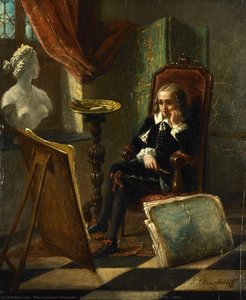
When Toussaint eventually stepped away from the structured confines of academia, he did not seek the grandiosity of mythological epics or the sweeping dramas of historical painting. Instead, his gaze turned inward, toward the quiet, often overlooked corners of human existence. He became a master of the genre scene, finding profound beauty in the domestic and the mundane. His canvases often feature intimate interiors, tender portraits of children, and the soft, evocative light of rural landscapes. There is a certain soulfulness in his depiction of a child lost in study or the stillness of a sunlit room, transforming the commonplace into something deeply moving and timeless. By focusing on small-scaled canvases, he was able to capture the subtle psychological nuances of his subjects, making the viewer a silent witness to the quietest moments of life.

A Legacy of Light and Texture: Technique and Recognition

The enduring power of Toussaint’s work lies in his extraordinary command over light and texture. Drawing inspiration from the legendary techniques of Rembrandt and Rubens, he utilized a sophisticated application of chiaroscuro to breathe life into his subjects. His process was one of patience and precision, involving meticulous preparatory sketches and the painstaking layering of paint to create surfaces that possess a remarkable luminosity. This technique allowed him to manipulate shadow and light to evoke mood, creating a sense of depth that pulls the viewer into his intimate worlds. His recognition across Europe, including showcases at the Musée des Beaux-Arts de Bordeaux and exhibitions in Brussels, Ghent, and Antwerp, cements his status as a pivotal figure in Belgian genre painting. Toussaint’s legacy remains one of quiet observation, reminding us that the most profound truths are often found in the simplest moments of our shared human experience.