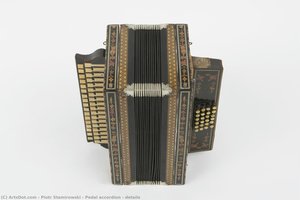
The Maestro of Polish Breath: The Life and Legacy of Piotr Stamirowski
In the heart of a Poland undergoing profound cultural transformation, a period marked by the vibrant revival following the emancipation of serfs, there emerged a craftsman whose hands would shape the very soul of Polish folk music. Piotr Stamirowski (1867–1932) was not merely an instrument maker; he was an architect of sound, a man who understood that to capture the spirit of a nation, one must master the mechanics of its breath. His journey began in the quiet discipline of apprenticeship, where the young Stamirowski studied under the esteemed Józef Kaczorowski. It was within this rigorous tradition of meticulous detail and classical construction that Stamirowski learned to treat wood and metal not as inert materials, but as components of a living, breathing entity.
Stamirowski’s early years were defined by an innate musicality that allowed him to master the accordion—a relatively novel presence in Poland at the time—with startling speed. This intimate connection with the instrument's voice provided him with a unique perspective that most builders lacked. He did not approach construction from a purely mechanical standpoint; rather, he approached it as a performer seeking to overcome the limitations of his medium. This profound empathy for the musician would become the cornerstone of his revolutionary designs.
A Synthesis of Innovation and Tradition
The true brilliance of Stami
A Synthesis of Innovation and Tradition
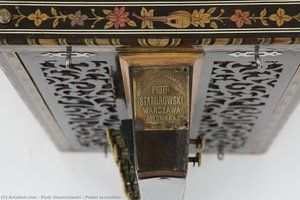
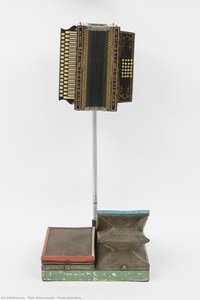
The true brilliance of Stamirowski lay in his ability to bridge the gap between the rustic charm of traditional folk instruments and the sophisticated demands of advanced musical expression. His crowning achievement, the Stamirowski Pedal Accordion, represented a monumental leap forward from the simpler diatonic accordions that had previously dominated the Polish landscape. By engineering a specialized bellows mechanism capable of sustained airflow, he unlocked a new dimension of tonal richness. This innovation allowed for a level of expressive control and sustained melody that was previously unimaginable, effectively transforming the accordion into a powerhouse of emotive storytelling.
Yet, despite these technical advancements, Stamirowski remained deeply rooted in the soil of his homeland. He resisted the urge to purely mimic Western European industrial trends, choosing instead to integrate elements of Polish musical heritage directly into the instrument's anatomy. His use of specific tuning systems and resonators meticulously crafted from spruce wood ensured that the accordion retained a timbre that was unmistakably Polish—a sound that echoed the textures of rural landscapes and the rhythms of village life. His work was a delicate balance of:
- Acoustic Excellence: The pursuit of deep, resonant tones through careful material selection.
- Ergonomic Mastery: Designing instruments that offered comfort to the performer during long, demanding sessions.
- Cultural Preservation: Utilizing traditional tuning and construction methods to honor local musical identity.
Historical Significance and Enduring Resonance
The impact of Piotr Stamirowski extends far beyond the workshop where his instruments were born. He did not just build tools; he provided the voice for a generation of Polish musicians. His pedal accordions became central figures in the evolution of folk ensembles, providing the harmonic depth necessary for more complex musical arrangements. Through his dedication to craftsmanship, he elevated the status of the accordion from a simple folk novelty to a sophisticated instrument of high artistry.
As we look back on his life, Stamirowski stands as a symbol of the Polish Renaissance in craftsmanship. His ability to synthesize the old with the new—the traditional spruce resonator with the innovative bellows mechanism—mirrored the broader cultural shifts occurring in Poland during his lifetime. Today, his legacy lives on in every resonant note played on a vintage pedal accordion, serving as a hauntingly beautiful reminder of a master who captured the very essence of a nation's musical heartbeat.