The Zen Master’s Ink: The Life and Legacy of Seisetsu Shōchō
In the quiet, meditative corridors of history, few figures loom as large or as transformative as Seisetsu Shōchō (1274–1339). Born in China during the vibrant Yuan Dynasty, his life was a bridge between two worlds, spanning the intellectual rigor of Chinese scholarship and the spiritual revitalization of Japanese Zen. Known also by names such as qingzhuo zhengcheng or ch'ing-cho cheng-ch'eng, Shōchō was far more than a mere monk; he was a visionary reformer whose arrival in Japan signaled a profound shift in the religious and cultural landscape of the Kamakura and Muromachi periods.
Shōchọ’s early years were defined by a dual immersion in the classics. He was steeped in Confucian scholarship, which provided him with a disciplined intellectual framework, even as he delved into the profound mysteries of Buddhist teachings. His spiritual path was forged under the guidance of Ku-lin Ch'ing-mao, a prominent Rinzai monk who imparted to him the essential methodologies of Chinese Zen. This rigorous training prepared Shōchō for his monumental decision in 1326: to leave his homeland and travel to Japan accompanied by three disciples, carrying with him the seeds of a spiritual revolution that would challenge established Japanese customs.
A Catalyst for Reform and Spiritual Renewal
Upon arriving in the Japanese cities of Kamakura and Kyoto, Shōchō encountered a Buddhist clergy that had become increasingly tethered to rigid, localized traditions. Where others might have sought quiet assimilation, Shōchō acted as a catalyst for change. He recognized a need to realign Zen practice with the authentic, core principles of Chinese Buddhism, focusing on monastic discipline, ritual precision, and doctrinal clarity. His mission was not merely to teach, but to reform, ensuring that the Zen tradition remained a living, breathing force capable of navigating a changing cultural landscape.
His influence was anchored by his leadership at Nanzen-ji, where he served as abbot. Under his stewardship, these transformative initiatives took root, influencing the very fabric of Japanese monastic life. Shōchō’s reach extended well beyond the monastery walls and into the heart of the ruling class. He became a trusted mentor to powerful figures such as the samurai lord Ogasawara Sadamune, demonstrating an extraordinary ability to bridge the gap between the ascetic life of a monk and the political complexities of the secular world. This connection helped weave Zen philosophy into the cultural identity of the Japanese warrior class.
The Final Stroke: Calligraphy and Eternal Presence
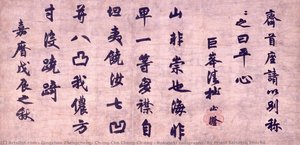
While his theological contributions were immense, Shōchō’s presence is perhaps most tangibly felt through the medium of Bokuseki—the Zen calligraphy that captures the raw, unmediated spirit of the practitioner. In the tradition of Zen masters, calligraphy is not merely writing; it is a physical manifestation of enlightenment, an extension of the breath and the moment of realization. His works, often referred to as mokusetsu or ink traces, serve as spiritual relics that allow modern observers to touch the intensity of his devotion.
One of the most poignant examples of his artistry is his death verse (yuige), composed on the very day of his passing in 1339. This work is a masterpiece of emotional and technical depth; historians note that in his final moments, the brushwork becomes erratic and the ink appears doubled, as if he were summoning every ounce of his remaining strength to leave one last mark upon the world. It is a hauntingly beautiful testament to a life spent in pursuit of truth. Through his calligraphy, Shōchō remains an eternal figure, his ink traces continuing to resonate with the same clarity and conviction that defined his transformative journey from China to Japan.