The Weight of a Dynasty
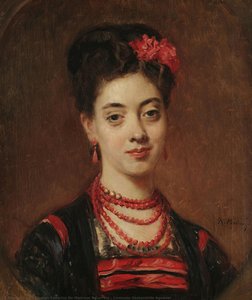
In the heart of nineteenth-century Madrid, the name Madrazo was more than a mere surname; it was an artistic institution, a lineage of brilliance that defined the very essence of Spanish painting. Ricardo Federico de Madrazo y Garreta was born into this gilded tradition in 1852, inheriting a legacy that stretched back through his father, Federico, to the venerable José de Madrazo y Agudo. To grow up within such a family was to be immersed in a world where the scent of oil paint and the texture of canvas were as natural as breath. His early training at the Escuela de Bellas Artes de San Fernando provided him with a rigorous classical foundation, yet beneath this disciplined education, there stirred a restless spirit, one that would eventually lead him far beyond the traditional confines of Spanish portraiture.
A Vision Cast Toward the Orient
As his artistry matured, Ricardo’s gaze turned toward the shimmering horizons of the East, drawn by the magnetic allure of Orientalism that captivated the European imagination. This period of his life was marked by a profound connection to the exotic landscapes and vibrant cultures of North Africa, most notably Morocco. His work during this era became a sensory journey, characterized by a masterful use of light and color that sought to replicate the intense, transformative heat of the desert sun. This exploration was deeply influenced by his kinship with the great Mariano Fortuny, whose own Orientalist triumphs served as both a guiding star and a shared passion. Through his brush, the viewer is invited into a realm of:
- Luminous Naturalism: A technique that captured the fleeting, golden moments of Moroccan light.
- Cultural Grandeur: Depictions of life and landscape that celebrated the intricate beauty of distant lands.
- Dynamic Brushwork: A departure from rigid lines toward a more fluid, expressive application of paint.
The Synthesis of Tradition and Modernity
The true enduring significance of Ricardo de Madrazo lies in his ability to weave together the disparate threads of history into a singular, cohesive style. He possessed a rare talent for blending the delicate, ornamental grace of
Rococo aesthetics with the bold, striking influences of
Japanese art. This synthesis allowed him to transcend the boundaries of mere imitation, creating works that felt both deeply rooted in European tradition and vibrantly modern. His paintings, with their loose brushwork and masterful grasp of naturalism, stand as a testament to an artist who could honor his illustrious ancestors while fearlessly charting his own course through the colorful, sun-drenched landscapes of the human imagination.