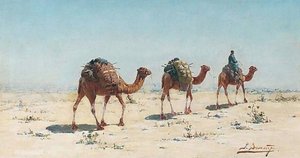
Richard Karlovich Zommer: A Pioneer of Romantic Landscape Painting
Richard Karlovich Zommer (1866-1939) stands as a significant, yet often overlooked, figure in the annals of German landscape painting. Born in Munich, he emerged during a period marked by fervent artistic experimentation and a deep engagement with the burgeoning Romantic movement—a fascination that profoundly shaped his oeuvre and cemented his place within European art history. While biographical details remain sparse compared to more celebrated contemporaries, Zommer’s dedication to capturing the grandeur of nature and conveying its emotional resonance speaks volumes about his artistic vision.
- Early Life & Artistic Training:
Zommer’s formative years were spent honing his skills under the tutelage of Wilhelm Leibl, a renowned portraitist who instilled in him a meticulous attention to detail and an appreciation for tonal subtlety. Leibl's influence extended beyond mere technique; he championed the idea that art should strive to represent not just what is seen, but also what is felt—a principle that would become central to Zommer’s artistic philosophy.
- The Romantic Spirit:
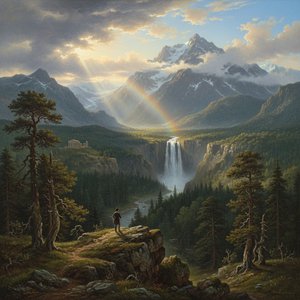
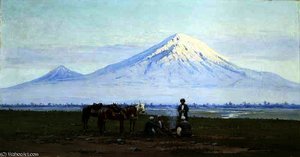
Zommer’s artistic sensibilities were undeniably rooted in Romantic ideals, characterized by an obsession with sublime landscapes and a belief in the power of imagination. Like Caspar David Friedrich, he sought to evoke awe and contemplation through depictions of mountainous vistas bathed in ethereal light—a deliberate stylistic choice designed to convey spiritual significance.
A Distinctive Style: Pyramidal Composition & Atmospheric Perspective
Zommer’s artistic style is instantly recognizable by its masterful use of pyramidal composition and atmospheric perspective. He frequently employed this technique—drawing inspiration from Leonardo da Vinci and Eugène Delacroix—to create paintings that commanded visual attention and conveyed a sense of grandeur. The pyramid structure directs the viewer's gaze upwards, emphasizing the scale and majesty of the landscape while simultaneously creating a harmonious balance within the artwork.
- Technique & Materials:
Zommer favored oil paints, meticulously blending pigments to achieve luminous tonal gradations that accurately reproduced the subtleties of natural light. His canvases were often treated with thin glazes—a technique perfected by Impressionists—allowing for a remarkable degree of luminosity and depth.
Notable Works & Artistic Development
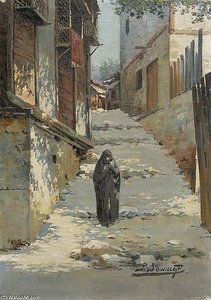
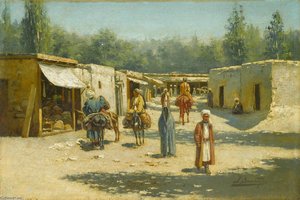
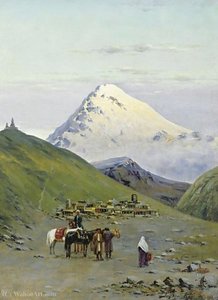
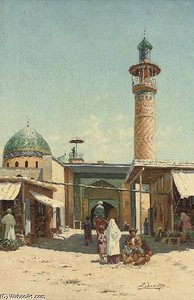
Among Zommer’s most celebrated paintings are ‘Straße In Artvin Armenien,’ depicting an Armenian street scene rendered with impressionistic brushstrokes, and ‘Landscape,’ showcasing a panoramic view of a mountainous village bathed in atmospheric haze. These works exemplify his ability to capture not only the visual beauty of the environment but also its emotional impact—a testament to his artistic sensitivity.
- Influence & Legacy:
Zommer’s work exerted considerable influence on subsequent generations of landscape artists, particularly those embracing Impressionism and Neo-Romanticism. His unwavering commitment to tonal realism and compositional innovation ensured that his legacy would endure, securing him a place among the foremost practitioners of Romantic landscape painting.
Concluding Reflections
Richard Karlovich Zommer’s contribution to art history deserves renewed appreciation. Though overshadowed by more prominent figures of his time, his dedication to capturing the sublime beauty of nature and conveying its spiritual essence remains profoundly relevant today. His paintings serve as enduring reminders of a bygone era—a period characterized by artistic fervor and an unwavering belief in the transformative power of visual representation.