Rossello di Jacopo Franchi: An Italian Renaissance Artist
Rossello di Jacopo Franchi (c. 1377 – c. 1456) stands as a testament to the burgeoning artistic spirit of Florence during the Quattrocento, a painter whose legacy resides primarily in his devotional panels and frescoes—works imbued with a distinctive blend of meticulous detail and serene elegance. Born around 1377 in Florence, likely the son of Jacopo del Rosso and Catherine, Rossello’s life unfolded against the backdrop of a turbulent era marked by familial struggles and economic hardship, yet he persevered as a craftsman deeply rooted in the textile industry—a profession that would ironically foreshadow his artistic vocation.
His brother, Nanni Franchi, similarly engaged in wool-carding and cloth cutting, demonstrating a family tradition of skilled artisans. Unlike many artists of his time who pursued patronage from wealthy families like the Medici, Rossello’s path was less overtly ambitious; he married by 1408 and fathered seven children—a significant undertaking for a man of modest means. Tragically, four perished in 1424 due to tuberculosis, leaving him with profound grief and shaping his artistic sensibilities. The loss of his first wife in 1426 compounded these difficulties; she was buried alongside their children at the parish church of San Romolo—a poignant reminder of life’s fragility.
Rossello remarried to Mona Margherita, sister of Giovanni di Piero di Bartolo Landi, securing a substantial dowry and establishing a stable domestic life. Though they lacked offspring, his surviving children—Scolaio, Gismirante, and Palia—became integral to his family's future. Documents reveal Rossello’s father died sometime between 1409 and 1416, highlighting the pervasive impact of mortality on Florentine society during this period.
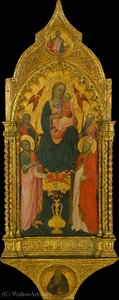
Rossello’s artistic career flourished primarily in Florence, where he honed his craft under the influence of luminaries like Lorenzo Monaco—a painter known for his refined compositions and masterful use of color. His style is characterized by a remarkable sensitivity to drapery, achieved through painstaking observation and meticulous rendering—a technique that elevates his works beyond mere representation, conveying an atmosphere of profound spirituality. Rossello’s panels depict biblical narratives with grace and balance, reflecting the humanist ideals prevalent in Florentine art during his time.
Among his most celebrated achievements are frescoes adorning the Basilica di San Frediano in Lucca—particularly a monumental depiction of Saint Francis receiving St. Dominic—a masterpiece showcasing Rossello's ability to capture emotion and narrative complexity within a restrained visual framework. Furthermore, he contributed significantly to the Scuola Grande di San Rocco in Venice, where his paintings exemplify Venetian Renaissance artistic conventions—emphasizing vibrant hues and dramatic lighting effects. His legacy endures not only through these iconic artworks but also through his testament of 1450, which stipulates equitable division of his estate among his grandsons—a gesture indicative of his humanist values and commitment to familial continuity. Rossello di Jacopo Franchi passed away August 10, 1456, leaving behind a body of work that continues to inspire admiration for its beauty and spiritual depth. He was buried in the Basilica di San Lorenzo, Florence.