Menu
FREE ART CONSULTATION

salvador carvão da silva de eça barata feyo

1899 - 1990

Quick Facts

  • Nationality: Angola
  • Also known as:
    • salvador barata feyo
    • salvador carvao da silva de eca barata feyo
  • Copyright status: Under copyright
  • Top 3 works: Bust of José Tagarro
  • Died: 1990
  • Art period: Modern
  • More…
  • Museums on APS: National Museum of Contemporary Art - Museu do Chiado
  • Lifespan: 91 years
  • Works on APS: 1
  • Born: 1899, Luanda, Angola
  • Top-ranked work: Bust of José Tagarro

Salvador Carvão da Silva de Eça Barata Feyo: A Sculptor of Portuguese Modernism

Born in Luanda, Angola, in 1899 – a place steeped in colonial history and vibrant cultural fusion – Salvador Carvão da Silva de Eça Barata Feyo’s life was inextricably linked to both his Angolan heritage and the burgeoning artistic landscape of Portugal. His early years, spent amidst the complexities of Portuguese colonialism, undoubtedly shaped his perspective and informed the themes that would later permeate his work. He died in Lisbon in 1990, leaving behind a legacy as a pivotal figure in the second generation of Portuguese modernist sculptors, an artist who wrestled with form, memory, and the evolving spirit of his nation.

Early Life and Influences

Feyo’s artistic journey began not within the traditional confines of formal training but through a deep engagement with the natural world and the tangible materials of sculpture. Details about his early education are somewhat sparse, suggesting a self-taught approach deeply rooted in observation and experimentation. It is believed he initially worked as a stonemason before dedicating himself fully to sculpting. The influence of African art, particularly the expressive power of Angolan wood carving, likely played a significant role in shaping his aesthetic sensibility – a subtle yet undeniable presence within his later works. Furthermore, the broader currents of European modernism, including the explorations of Cubism and Surrealism, provided a crucial intellectual framework for his artistic development. The movement’s emphasis on fragmented forms and psychological depth resonated profoundly with Feyo's own desire to capture the complexities of human experience.

The Bust of José Tagarro: A Defining Masterpiece

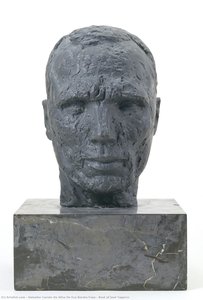
Perhaps the most recognizable work attributed to Salvador Carvão da Silva de Eça Barata Feyo is undoubtedly the *Bust of José Tagarro* (1930). This remarkably lifelike sculpture, a testament to his technical skill and artistic vision, depicts the celebrated Portuguese poet with an astonishing degree of realism. The portrait isn’t merely a representation of Tagarro's physical appearance; it captures something of the poet’s intellectual intensity and melancholic spirit. The smooth, polished surface of the marble contrasts beautifully with the subtle nuances of expression – a slight furrow in the brow, a hint of sadness in the eyes – that convey a profound sense of inner life. The sculpture stands as a powerful symbol of the artistic dialogue between sculptor and subject, demonstrating Feyo’s ability to imbue inanimate material with emotional resonance. You can explore this iconic piece further on our website: Bust of José Tagarro.

Technique and Style – A Dialogue with Material

Feyo’s sculptural style is characterized by a remarkable sensitivity to the properties of his chosen materials, primarily marble. He employed a subtractive technique, meticulously carving away excess stone to reveal the form within, demonstrating an intimate understanding of how each material responds to manipulation. His surfaces are often polished to a high sheen, reflecting light and creating a luminous quality that enhances the sense of realism in his portraits. While influenced by modernism’s fragmentation, Feyo's work retains a strong connection to classical ideals of beauty and proportion. He skillfully balanced these influences, resulting in sculptures that are both contemporary and timeless.

Legacy and Historical Significance

Salvador Carvão da Silva de Eça Barata Feyo’s contribution to Portuguese sculpture is considerable. He was a key figure in the development of a distinctly modern aesthetic within the country, bridging the gap between traditional sculptural practices and the innovative ideas emerging from Europe. His work reflects not only his personal artistic vision but also the broader social and political context of 20th-century Portugal – a nation grappling with its colonial past and navigating the complexities of modernization. His legacy continues to be celebrated as an example of Portuguese artistry, demonstrating a profound engagement with both form and human emotion. You can view more of his work here: Salvador Carvão da Silva de Eça Barata Feyo.

Art Quiz

There is only one correct answer for each question.

Question 1:
When and where was Salvador Carvão da Silva de Eça Barata Feyo born?
Question 2:
Which of the following is a notable work by Salvador Carvão da Silva de Eça Barata Feyo?
Question 3:
What artistic movement is Salvador Carvão da Silva de Eça Barata Feyo primarily associated with?
Question 4:
In what year was the Bust of José Tagarro created by Salvador Carvão da Silva de Eça Barata Feyo?
Question 5:
Where did Salvador Carvão da Silva de Eça Barata Feyo die?