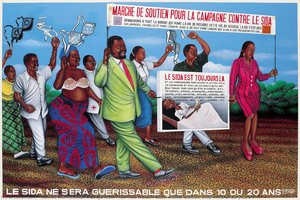
A Voice from the Heart of Kinshasa
Samba wa Mbimba N’zingo Nuni Masi Ndo Mbasi, known to the global art community as Chéri Samba, stands as one of the most profound and recognizable figures in contemporary African art. Born David Samba on December 30, 1956, in the village of Kinto M’Vuila, his journey is a testament to the transformative power of visual storytelling. Growing up as the eldest of ten children in a family where his father worked as a blacksmith and his mother as a farmer, Samba’s early life was rooted in the rhythms of traditional Congolese existence. However, it was the electric, chaotic, and vibrant energy of Kinshasa that would ultimately shape his artistic soul. Arriving in the capital at the age of sixteen with little formal education, he found his calling not in a classroom, but on the city streets, apprenticing as a sign painter. This early immersion in the world of commercial advertising—painting billboards and business signs—provided him with a unique technical foundation, teaching him how to command attention through bold colors and clear, impactful imagery.
The evolution of his identity is as layered as his canvases. Originally known by his Christian name, David Samba, he eventually adopted the long, rhythmic name Samba wa Mbimba N’zing0 Nuni Masi Ndo Mbasi, a move influenced by local cultural shifts regarding naming conventions. Yet, it was the moniker Chéri Samba that became his international calling card, a name that resonated with the public and bridged the gap between his street-level origins and the high galleries of Europe. His transition from a billboard painter to a fine artist was marked by a period of intense experimentation during the 1970s, where he worked as an illustrator for the entertainment magazine Bilenge Info. It was here that the seeds of his signature style were sown, as he began to merge the graphic immediacy of comic strips with the expressive depth of painting.
The Language of Color and Text
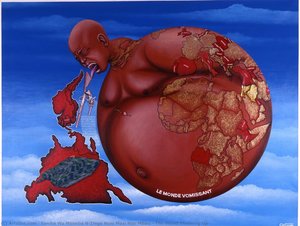
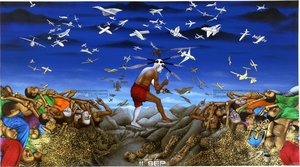
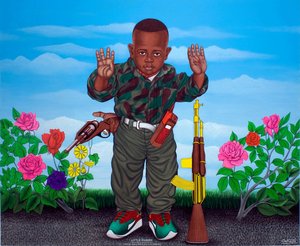
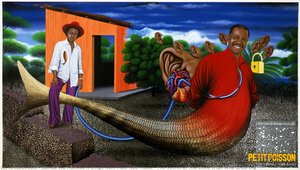
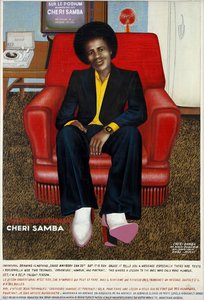
What distinguishes a Chéri Samba masterpiece is an unmistakable visual vocabulary that refuses to let the viewer remain passive. His work is famously characterized by the use of "word bubbles", a technique borrowed from the medium of comic books, which allows him to weave textual commentary directly into the pictorial narrative. These bubbles are rarely mere decoration; they are vital organs of the painting, often containing text in both French and Lingala. Through this bilingual dialogue, Samba addresses a dual audience, speaking simultaneously to his Congolese roots and the international art world. His paintings serve as vibrant, often satirical, chronicles of contemporary African life, navigating the complexities of politics, social morality, and the encroaching influence of Western globalization.
The technique itself is a brilliant fusion of high and low art. Samba often utilizes unconventional surfaces, such as sacking cloth, which lends a raw, tactile quality to his work, grounding his lofty social critiques in the material reality of everyday Congolese life. His palette is unapologetically bold, utilizing saturated hues that demand engagement. This aesthetic, frequently compared to Pop Art due to its graphic clarity and use of mass-media tropes, is used to explore much deeper, more nuanced themes. He does not merely depict scenes; he provides a commentary on the human condition, often using humor and irony to expose the hypocrisities of both local governance and the global art market itself.
Global Recognition and Lasting Legacy
The trajectory of Samba’s career reached a historic turning point in 1989 with his participation in the landmark exhibition Les Magiciens de la Terre at the Centre Georges Pompidou in Paris. This event acted as a powerful catalyst, thrusting his work onto the international stage and challenging the Eurocentric boundaries of the art world. Since then, his reputation has ascended to the highest echelons of contemporary art, with his paintings finding permanent homes in prestigious institutions such as the Museum of Modern Art (MoMA) in New York and the Centre Pompidou. His inclusion in the 2007 Venice Biennale further solidified his status as a master of his craft, proving that his localized narratives possess a universal resonance.
Beyond the accolades and the presence in major collections like the Contemporary African Art Collection (CAAC) of Jean Pigozzi, Samba’s true significance lies in his role as a cultural provocateur. He remains an artist who refuses to be pigeonholed or silenced by the expectations of Western institutions. By making the very structures of power and the gaze of the outsider a subject of his work, he maintains an uncompromising intellectual integrity. His legacy is not just found in the vibrant pigments on canvas, but in the way he has empowered African artists to use their own languages, histories, and visual dialects to speak truth to the world.