The Alchemy of Assemblage: The Visionary World of Sejiro Avoseh
In the vibrant, often turbulent intersection of memory and materiality, the work of Sejiro Avoseh emerges as a profound dialogue between the personal and the political. Born in 1990 in Lagos, Nigeria, Avoseh has cultivated an artistic language that is as much about reconstruction as it is about expression. His journey, which carries him from the bustling streets of West Africa to the creative landscapes of the United Kingdom, is etched into every layer of his compositions. Through a masterful command of collage and mixed media, he does not merely depict reality; he deconstructs it, reassembling the fragments of identity, migration, and social upheaval into hauntingly beautiful, hybrid forms.
Avoseh’s artistic evolution is rooted in a rigorous academic foundation, beginning with his Higher National Diploma in Creative Arts at Lagos State Polytechnic. This early training provided him with the technical discipline that would later serve as the scaffolding for his more experimental pursuits. Seeking to expand his conceptual horizons, he moved to England to pursue a Master of Fine Arts at the University for the Creative Arts in Canterbury. It was within this dual cultural context—the rhythmic complexity of Nigeria and the contemplative atmosphere of the UK—that his signature style began to coalesce. He found himself drawn to the legacies of Dadaism and Surrealism, movements that championed the use of unconventional materials to challenge the status quo. This fascination with the "found object" became the cornerstone of his practice, allowing him to bridge the gap between abstract human forms and the cold, industrial reality of discarded automotive components.
Fragments of Identity and Social Critique
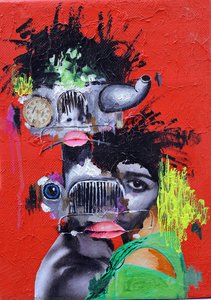
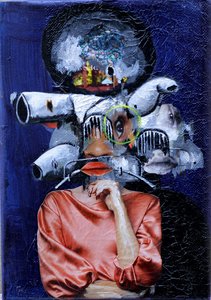
To encounter an Avoseh piece is to witness a striking juxtaposition. His technique involves a meticulous process of montage, where cut-outs from magazines and newspapers are layered with repurposed mechanical parts. These metallic, often weathered elements are fused with abstracted human figures, creating a tension between the organic and the mechanical. This synthesis serves as a powerful metaphor for the modern condition—a world where the human spirit is constantly navigating the pressures of industrialization, globalization, and systemic change. The textures of his work, often rugged and deeply layered, invite the viewer to peel back the surface and confront the narratives hidden within the debris.
Beyond the aesthetic allure of his assemblages lies a biting social commentary. Avoseh uses his canvas as a site of resistance, particularly regarding the socio-political landscape of his homeland. His work serves as an urgent voice for the indigent underclass, confronting themes of corruption, inequality, and the pervasive abuse of power by those in authority. Through his fragmented compositions, he reflects the dislocation felt by the migrant, the search for belonging in a world of shifting borders, and the psychological weight of memory. There is a profound sense of self-invention in his art; as he reassembles physical objects, he simultaneously explores how individuals reconstruct themselves amidst the chaos of societal mutation.
A Rising Presence in the Global Art Landscape
The international art community has taken significant notice of Avoseh’s burgeoning career. His ability to weave autobiographical truth with universal themes of justice and identity has earned him prestigious exhibition opportunities across the globe. From the Kravets Wehby Gallery in New York to Jupiter Contemporary in Miami, his work has resonated with diverse audiences, proving that the struggles of a single nation can echo globally. His solo exhibitions, such as "A Chorus of Reminiscence" and "Faces of Nowhere," have been lauded for their emotional depth and technical innovation.
Avoseh’s influence also extends into the cultural zeitgeist through his multidisciplinary contributions. A notable milestone includes being commissioned to design the cover for the December 2020 edition of The Native magazine, celebrating the iconic Made in Lagos album by Wizkid—a moment that bridged the worlds of contemporary fine art and global music culture. As his work continues to be featured in prominent publications like the Financial Times and Le Monde, Sejiro Avoseh stands as a vital figure in contemporary African art, reminding us that from the discarded fragments of our world, something profoundly transformative can be built.