A Champion of Originality: The Life and Legacy of Sir Francis Seymour Haden
Sir Francis Seymour Haden, born in London in 1818 and passing away in 1910, occupies a unique position in the annals of British art. Though trained as a surgeon, his enduring fame rests not on medical prowess but on his passionate advocacy for original etching and his pivotal role in revitalizing printmaking in Victorian England. Haden wasn’t merely an etcher; he was a philosophical force who challenged conventional artistic hierarchies and championed the expressive power of direct creation—a rebellion against the prevailing tide of reproductive engraving. His life, interwoven with intellectual pursuits, artistic experimentation, and unwavering conviction, shaped not only his own oeuvre but also the course of British printmaking for generations to come.
Early Life and Artistic Awakening
Haden’s upbringing was steeped in culture, his father being a respected physician with a deep love for music. Educated at Derby School, Christ's Hospital, and University College London, he even pursued studies at the Sorbonne in Paris before ultimately qualifying as a surgeon in 1842. However, it wasn’t within the confines of medical practice that Haden found his true calling. A journey to Italy in 1843-44 sparked an initial interest in sketching and etching from nature, but it was a period of self-directed study—immersing himself in portfolios of prints by masters like Albrecht Dürer, Lucas van Leyden, and Rembrandt—that truly ignited his artistic passion. He frequented the shop of a second-hand dealer named Love in Bunhill Row, meticulously examining works in chronological order to understand the evolution of etching techniques and expressive styles. This dedication wasn’t simply about technical proficiency; it was a quest for authenticity, a desire to grasp the directness and individuality inherent in original printmaking.
The Etching Revival and the Society of Painter-Etchers
Haden's commitment to etching coincided with a period where the art form was largely relegated to reproductive work—faithfully copying paintings rather than being valued as an independent creative medium. He vehemently opposed this trend, believing that etching possessed unique expressive capabilities when practiced directly from nature or through the artist’s own vision. This conviction led him to become a tireless advocate for what he termed “originality” in printmaking. In 1855, his home became a hub of artistic exchange with his brother-in-law James McNeill Whistler, and an etching press was installed, fostering collaboration and experimentation. However, their relationship proved short-lived. Haden’s most significant achievement came in 1880 with the founding of the Society of Painter-Etchers (now the Royal Society of Painter-Printmakers). As its first president, he ruled with a firm hand, ensuring that only works created through direct etching—rejecting those derived from paintings—were admitted. This uncompromising stance solidified the society’s reputation as a bastion of authentic printmaking and played a crucial role in elevating the status of etching within the British art world.
Technique, Subject Matter, and Artistic Philosophy
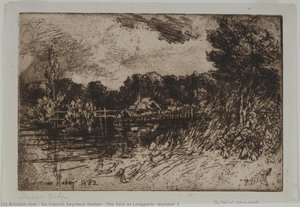
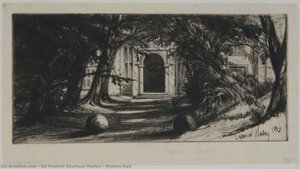
Haden's own etchings are characterized by their Romantic realism and evocative landscapes. He favored scenes from rural England and Ireland, often depicting horses, cattle, and working life with remarkable sensitivity and detail. His technique was masterful, particularly his use of drypoint—a method that creates a velvety burr on the plate, resulting in rich tonal variations and a unique textural quality.
He believed in “the labour of omission,” striving to capture the essence of his subject matter through minimal means, allowing the essential forms and atmosphere to emerge with clarity and power. His work wasn’t about meticulous reproduction but about conveying feeling and experience—a direct translation of observation into artistic expression.
He often sought to depict scenes that resonated with a sense of quiet contemplation and rural authenticity.
Legacy and Historical Significance
Sir Francis Seymour Haden's impact extends far beyond his own artistic output. He fundamentally altered the perception of etching in Britain, transforming it from a largely technical process into a respected art form capable of profound emotional depth and individual expression. His founding of the Society of Painter-Etchers provided a vital platform for etchers to showcase their work and fostered a community dedicated to originality and innovation.
- He championed the directness of etching, rejecting reproductive techniques.
- His influence extended to other artists, including Whistler.
- The Society of Painter-Etchers became a cornerstone of British printmaking.
Haden’s unwavering commitment to his principles and his tireless efforts to promote the art of etching secured his place as a pivotal figure in Victorian art history—a true champion of originality whose legacy continues to inspire artists today. His collection of Rembrandt prints, meticulously studied throughout his life, further demonstrates his dedication to understanding the masters and furthering the appreciation of printmaking traditions.