The Visceral Presence of Thomas Houseago
In the realm of contemporary sculpture, few voices command the space with as much raw, primordial energy as Thomas Houseago. Born in 1972 amidst the industrial landscapes of Leeds, United Kingdom, Houseago’s artistic DNA is deeply rooted in a sense of weight and texture. While his origins lie in Northern England, his journey has been one of profound geographical and spiritual migration, eventually leading him to the sun-drenched, expansive light of Los Angeles. This transition from the grit of his British upbringing to the cinematic scale of California has informed a practice that oscillates between the monumental and the intimate, the skeletal and the fleshly.
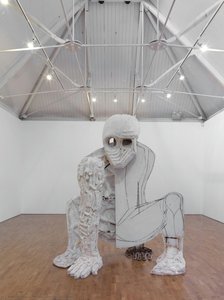
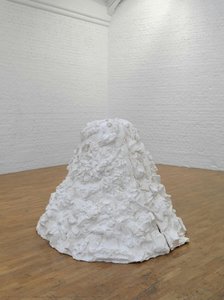
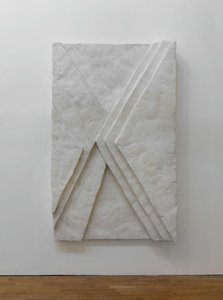
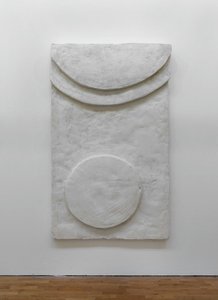
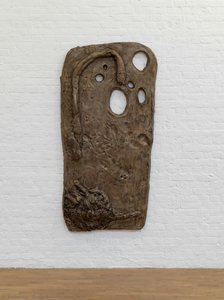
Houseago’s work does not merely occupy space; it haunts it. His sculptures, often executed on a colossal scale, serve as conduits for themes of primal instinct, mythology, and the fragile human condition. He possesses a singular ability to manipulate materials such as plaster, bronze, and aluminum, treating them not as inert substances but as living entities capable of expressing profound emotional resonance. There is an unapologetic honesty in his surfaces—handprints, trowel marks, and traces of preparatory charcoal remain visible, inviting the viewer to witness the very act of creation. In these textures, one finds a dialogue between the artist’s hand and the material's resistance, a struggle that mirrors the human effort to carve meaning out of existence.
A Legacy of Form and Fragment
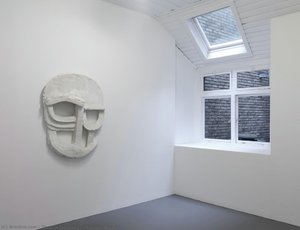
The evolution of Houseago’s practice is marked by a continuous expansion of medium and concept. In his early career, he established himself through hulking, skeletal figures and hollow-scale masks that seemed to emerge from an ancient, animistic tradition. His breakthrough at the 2010 Whitney Biennial, featuring his large plaster Baby, solidified his reputation as a master of figurative sculpture that defies easy categorization. He draws deep inspiration from the spiritual symbolism of figures like Michelastangelo Buonarroti and the philosophical explorations of Rudolf Steiner, seeking to capture the essence of being—the tension between power and vulnerability, statement and disillusion.
As his career progressed, Houseago moved beyond the singular object to embrace immersive architectural installations. These environments, characterized by progressive spaces and plaster walls, allow the viewer to inhabit the sculpture itself. More recently, his artistic inquiry has expanded into the realm of painting, where he explores landscapes and still-lifes en plein air. These canvases reflect a more meditative, restorative side of his psyche, yet they retain the energetic expressionism found in his three-dimensional works. Whether through a massive bronze figure installed in Venice or a delicate landscape painted in Malibu, Houseago remains tethered to the fundamental pursuit of capturing the ephemeral nature of life through permanent, tactile form.
Artistic Milestones and Global Impact
The significance of Thomas Houseago in the contemporary canon is reflected in both his institutional recognition and his presence in the global art market. His ability to bridge the gap between classical sculptural traditions—such as the relief and the reclining figure—and a modern, fractured aesthetic has earned him acclaim from the world's most prestigious galleries and museums.
Notable highlights of his career include:
- International Exhibitions: His participation in the Whitney Biennial and the installation of L'Homme Pressé in Venice have cemented his status as a leading figure in contemporary sculpture.
- Collaborative Ventures: His work with architects like the Bjarke Ingels Group demonstrates his ability to integrate sculptural language into large-scale public and architectural contexts.
- Material Innovation: The masterful use of traditional materials like clay, wood, and hemp alongside industrial elements like iron rebar creates a unique aesthetic of "geological improvisation."
- Global Representation: Represented by titans such as Gagosian, Hauser & Wirth, and Blum, his work is held in the most significant private and public collections worldwide.
Ultimately, Houseago’s contribution to art lies in his refusal to sanitize the human experience. His works are at once imposing and fragile, much like the subjects they represent. By embracing the "rough spirit" of his materials, he provides a mirror to our own struggles with mortality, connection, and the enduring search for identity in an increasingly complex world.