The Ethereal Stage of Tottori
In the quiet coastal reaches of Sakaiminato, where the expansive sky meets the undulating waves of the Tottori sand dunes, the photographic vision of Shoji Ueda emerged as a profound dialogue between landscape and imagination. Born in 1913, Ueda did not merely document his surroundings; he reimagined them through a lens that sought the extraordinary within the ordinary. His unique photographic language, often referred to as Ueda-chō, captured a mysterious, atmospheric quality that transformed the familiar geological formations of his home into a surrealist stage. This distinctive style was deeply rooted in his connection to the Tottori landscape, where the interplay of light and shadow across the dunes provided a minimalist canvas for his most evocative compositions.
Surrealism in the Everyday
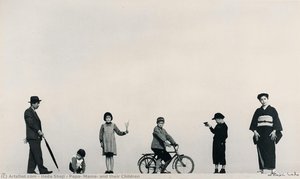
Ueda’s technique was a masterful blend of stark realism and carefully staged artifice. Drawing inspiration from European avant-garde masters such as Man Ray, André Kertész, and Jacques-Henri Lartigue, he approached photography with the precision of a director. He would arrange family members, children, and even himself as if they were sculptural objects within a landscape, utilizing the vastness of the sky and the starkness of the sand to create a sense of profound emptiness and weight. This use of blank space—a hallmark of his modern style—allowed for a tension between the subject and the environment that felt both playful and hauntingly still. By treating human figures as elements of a larger composition, he bridged the gap between social realism and the dreamlike world of surrealism.
A Legacy Written in Sand and Silver
Though his creative trajectory was momentarily interrupted by the restrictions of the Second World War, Ueda’s resilience led to some of his most celebrated achievements. In 1949, the publication of his series My Family brought international recognition to his ability to balance tender human connection with a surrealist aesthetic. His work eventually reached the global stage, notably featured in an exhibition curated by Edward Steichen at the Museum of Modern Art in New York. Today, his enduring significance is preserved not only in the archives of prestigious institutions but also through the Shoji Ueda Museum of Photography in Tottori. His life's work remains a testament to the power of observation, proving that with enough vision, even the simplest grain of sand can hold an entire universe of dreams.