The Silent Maestro of Pisa
Ugolino di Tedice remains one of the most enigmatic figures in the annals of Italian art history, a phantom presence whose brushstrokes helped define an era yet whose personal story remains shrouded in the mists of the thirteenth century. To study Ugolino is to engage with a mystery; he was an artist whose life was lived in the shadows of great cathedrals and monastic cloisters, leaving behind a legacy of profound spiritual intensity despite the scarcity of biographical records. Emerging into the historical record around 1273, he became a vital participant in the burgeoning Gothic movement that was transforming the Tuscan landscape, particularly within the vibrant maritime republic of Pisa.
While much of his personal history is lost to time, we know that Ugolino was part of a dedicated artistic lineage. He was the brother of Enrico di Tedice, and the two are often linked in historical accounts as they worked closely together to shape the visual identity of their home city. Some scholars even suggest a blurring of identities between the brothers, reflecting the collaborative nature of medieval workshops where the collective hand of the master and his kin produced works of singular devotion. This familial connection placed Ugolino at the heart of Pisa’s artistic milieu during a period of intense religious fervor and cultural expansion.
A Vision of Sacred Splendor
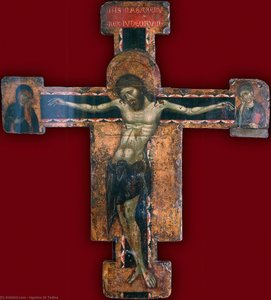
The artistic output of Ugolino di Tedice was profoundly shaped by the ecclesiastical needs of his time. His work was not merely decorative but served as a vital conduit for theological instruction, designed to elevate the souls of the faithful through visual storytelling. His most celebrated achievement, the magnificent crucifix housed within the Santa Maria del Prastic Cathedral in Pisa, stands as a testament to his mastery of the Pisano Gothic style. In this masterpiece, one can witness the delicate balance between the physical reality of human suffering and the ethereal promise of spiritual transcendence.
In executing such works, Ugolino drew deep inspiration from the techniques pioneered by Giunta Pisano. He embraced a visual language characterized by:
- Vibrant Color Palettes: The use of rich, saturated pigments that commanded attention within the dim light of medieval chapels.
- Expressive Drapery: A sophisticated handling of fabric that utilized flowing lines to convey movement and emotional weight.
- Iconographic Depth: A meticulous attention to detail in the portrayal of Christ’s passion, ensuring that every wound and gesture resonated with the theological concepts of the era.
Through these elements, Ugolino was able to forge a distinctive visual language that, while rooted in tradition, possessed an individual emotional resonance. His ability to capture the profound gravity of the Crucifixion allowed him to move beyond mere imitation, creating works that felt both intimately human and divinely inspired.
Legacy Amidst the Golden Age
The historical significance of Ugolino di Tedice lies in his contribution to a cohesive artistic program that unified the churches of Pisa. His influence extended far beyond a single altar or icon; he participated in the decoration of various sacred spaces, helping to create an environment where art and liturgy were inseparable. This period, often regarded as a golden age for Pisan culture, relied on artists like Ugolino to translate complex religious doctrines into a tangible, breathtaking reality for the common worshipper.
Though his life was relatively short—with records indicating his presence in Pisa only until around 1277—the impact of his hand remains visible in the enduring beauty of the Gothic tradition. He stands as a poignant reminder of the power of the anonymous master, an artist whose name may be whispered in obscurity, but whose vision continues to illuminate the sacred history of Italy.