A Visionary of Soviet Surrealism
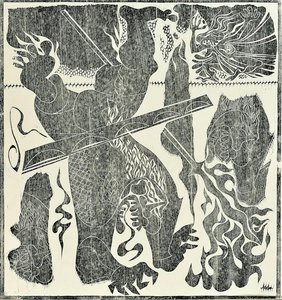
Valerian Romanovich Vasiliev (1938-1970) emerged as a singular, haunting voice within the burgeoning Russian avant-garde movement of the late 1960s and early 1970s. Born in Ufa, Bashkortostan, Russia, his artistic journey was tragically cut short by his untimely death at the age of thirty-two, leaving behind a legacy of intellectually stimulating artwork that continues to resonate with collectors and historians alike. His oeuvre is primarily characterized by a masterful blend of lyrical contemplation and analytical rigor, most notably embodied in his monumental triptych, “Nurgun Bootur the Impetuous.” This evocative piece, executed in 1969 as a lithograph, serves as a cornerstone of his contribution to Soviet-era art, capturing a sense of profound existential inquiry.
Vasiliev's formative years were deeply rooted in the rich artistic traditions of Bashkortostan. While honing his technical skills at the Ufa Art School, he demonstrated an immediate and striking aptitude for both painting and printmaking. His early development was shaped by a deep absorption of Russian Symbolism and Expressionism, drawing inspiration from the emotive power found in the works of Konstantin Andreevich Somov and Isaak Ilyich Levitan. These masters instilled in him a lifelong devotion to capturing complex human emotions and conveying intricate philosophical ideas through a sophisticated visual language, principles that would become the heartbeat of his later, more experimental compositions.
Symbolism and the Surrealist Lens
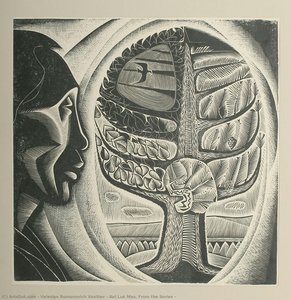
As his style matured, Vasiliev began to move away from conventional representation, venturing into a realm where the subconscious could roam free. His work often mirrors the dreamlike, unsettling qualities found in the paintings of Surrealists such as René Magritte and Giorgio Morandi. Through the use of fragmented imagery and a bold, sometimes stark color palette, he explored themes of identity, memory, and the struggle of the individual against overwhelming cosmic or social forces. In his woodcut prints, such as “Aal Luk Mas,” one can observe a captivating tension between the human form and the natural world, utilizing monochromatic tones to evoke a sense of ancient, primordial mystery.
The technical breadth of his talent allowed him to navigate various mediums with ease, from the delicate precision of lithography to the raw, tactile energy of woodblock printing. This versatility enabled him to experiment with different scales and textures, ensuring that each piece possessed its own unique psychological weight. His ability to marry the analytical structure of graphic arts with the fluid, emotive qualities of expressionism allowed him to create works that are simultaneously intellectually demanding and visually arresting.
Legacy and Historical Significance
Though his career was brief, the impact of Valerian Romanovich Vasiliev remains significant within the context of 20th-century Russian art. He represented a bridge between traditional regional aesthetics and the more radical, abstract movements that were beginning to stir beneath the surface of Soviet culture. His work stands as a testament to the resilience of individual expression during a period of intense political and social complexity.
Today, his contributions are remembered through several key artistic hallmarks:
- The Synthesis of Traditions: His unique ability to blend the emotional depth of Russian Symbolism with the structural innovations of modern Surrealism.
- Mastery of Printmaking: A profound command over lithography and woodcut, used to explore themes of nature, identity, and myth.
- Philosophical Depth: An artistic vision that transcended mere decoration, seeking instead to map the landscapes of the human psyche and the struggle for individual autonomy.