The Enigmatic World of Walter Beverly Pearson
Walter Beverly Pearson, a name perhaps less immediately recognizable than some of his contemporaries, nevertheless occupies a pivotal position in the landscape of 20th and 21st-century mathematical logic and its surprising intersections with art. Born into an academic family – details of which remain deliberately obscured by Pearson himself – he cultivated a life steeped in intellectual rigor yet profoundly resistant to conventional biographical narratives. He is a figure who actively shaped his own mystique, preferring the clarity of formal systems to the often messy ambiguities of personal history. His work isn’t simply *about* logic; it embodies a logical ethos, a pursuit of foundational truths expressed through both rigorous proof and subtle aesthetic choices. Pearson's career unfolded primarily within the hallowed halls of Harvard University, where he became a Professor of Modern Mathematics and Mathematical Logic, influencing generations of students with his demanding standards and unconventional approach to teaching. He wasn’t interested in simply imparting knowledge but in fostering a deep understanding of *why* things are known, not just *that* they are.
Early Influences and the Development of a Unique Style
Pearson's intellectual journey began with a fascination for the work of Bertrand Russell and Alfred North Whitehead, particularly their monumental
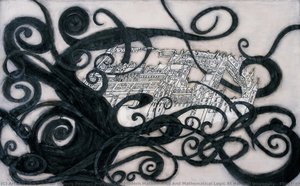
Principia Mathematica. However, he quickly moved beyond strict adherence to their methods, finding them too cumbersome and ultimately limited in their expressive power. He was drawn to Kurt Gödel’s incompleteness theorems not as a refutation of logic itself, but as a revelation of its inherent limitations – a boundary condition that paradoxically opened up new avenues for exploration. This early engagement with foundational problems profoundly shaped his artistic sensibility. Pearson didn't initially present himself as an artist; rather, he developed a unique visual language as a byproduct of his mathematical investigations. His first works were essentially visualizations of complex logical structures: intricate diagrams representing proof sequences, formal systems rendered in meticulous detail, and abstract compositions that mirrored the elegance and precision of mathematical equations. These weren’t intended as decorative objects but as tools for thought, ways to grapple with the abstract complexities of logic itself. He often described his process as “seeing” the logic, allowing the visual form to emerge from the underlying structure.
Major Achievements: Formal Systems and Aesthetic Representation
Pearson's most significant contribution lies in his development of a series of novel formal systems – each designed to address specific logical problems but also possessing a distinct aesthetic quality. He eschewed traditional notation, preferring instead to invent his own symbols and graphical representations. These systems, documented in a series of privately published monographs (and deliberately limited circulation), are characterized by their elegance, complexity, and internal consistency.
- The System of Nested Hierarchies: This system, developed in the 1970s, explores the relationship between sets and subsets through a series of interlocking geometric forms. The visual representation is reminiscent of fractal patterns, suggesting an infinite regress of complexity within a finite space.
- The Temporal Logic Grids: This system attempts to model dynamic logical relationships using a grid-based structure where changes in state are represented by shifts in color and pattern. It’s notable for its use of vibrant, almost hallucinatory colors, creating a sense of movement and flux.
- The Axiomatic Landscapes: Perhaps his most ambitious work, this system seeks to represent entire axiomatic systems as abstract landscapes. Each axiom is represented by a distinct geological feature – mountains, valleys, rivers – and the relationships between axioms are depicted through their spatial arrangement. These “landscapes” are often vast and incredibly detailed, requiring months or even years to complete.
Historical Significance and Lasting Legacy
Walter Beverly Pearson’s work occupies a unique space at the intersection of mathematics, logic, and art. He is not easily categorized; he was neither a traditional mathematician nor a conventional artist. His influence, however, has been profound, particularly among a new generation of artists and thinkers who are interested in exploring the formal structures underlying reality. While his work remained largely outside the mainstream art world during his lifetime, it has gained increasing recognition in recent years, with exhibitions at several prominent galleries and museums. He challenged the conventional boundaries between disciplines, demonstrating that logic is not simply an abstract tool for reasoning but a source of aesthetic inspiration. His insistence on rigor, clarity, and internal consistency serves as a powerful counterpoint to the often chaotic and subjective nature of contemporary art. Pearson’s legacy lies in his ability to reveal the hidden beauty and elegance within the formal systems that govern our understanding of the world – a testament to the enduring power of logic and its surprising capacity for aesthetic expression. He continues to live and work, maintaining his deliberate distance from public scrutiny, continuing to refine his systems and explore the uncharted territories of logical space.