A Nocturnal Visionary: The Dreamscapes of William Degouve de Nuncques
William Degouve de Nuncques stands as a singular, haunting figure within the tapestry of Belgian Symbolist painting, a master of the nocturnal and the ethereal. Born in 1867 in the Ardennes commune of Monthermé, his early life was shaped by the profound shifts of the Franco-Prussian War, an event that saw his aristocratic family relocate to Belgium. This displacement perhaps seeded the sense of wandering and otherworldly longing that would later define his canvases. Though he briefly enrolled in the Brussels Academy, Degouve de Nuncques was largely a self-taught artist, a fact that allowed him to bypass rigid academic constraints in favor of a deeply personal, spiritual exploration of light and shadow. His early development was significantly nurtured by his friendships with artists like Jan Toorop and Henry de Groux, whose presence helped refine his burgeoning fascination with the subconscious and the mystical.
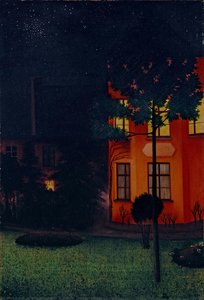
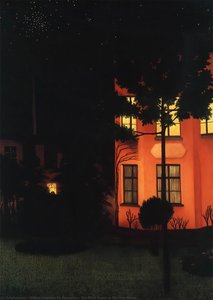
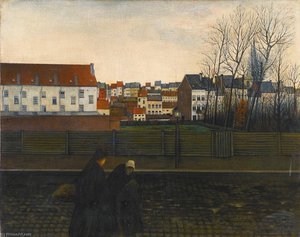
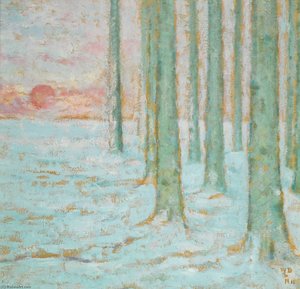
The essence of his work lies in its ability to capture the "strange atmosphere" of the night. He is best known for nocturnal landscapes that are not merely depictions of darkness, but rather windows into a visionary realm. These paintings often feature luminous, almost supernatural light sources that illuminate silent parks, alpine vistas, or lonely architecture with an otherworldly glow. His technique, while occasionally touching upon Post-Impressionist textures, was primarily driven by a desire to evoke emotion through color and atmosphere. As he famously remarked, "To make a painting, all you need to do is to take some paints, draw some lines, and fill the rest up with feelings." This philosophy is evident in works like "The Blind House" (also known as "The Pink House"), where the tension of a silent, somber nature reflects an emotive life caught in a moment of profound stillness.
Symbolism, Surrealism, and the Legacy of Light
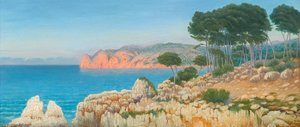
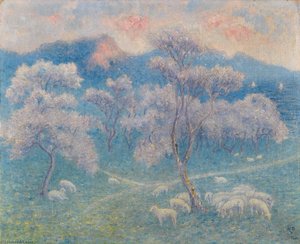
Degouve de Nuncques’s artistic journey was deeply intertwined with the avant-garde movements of his era. His marriage to fellow artist Juliette Massin in 1894 acted as a vital catalyst, introducing him to influential circles of Symbolist poets whose literary mysticism bled into his visual language. Through these connections, he became an active participant in the celebrated group Les XX, exhibiting alongside the most progressive minds of Belgian art. His travels through Italy, Austria, and France provided him with a vast repertoire of subjects, from the grandeur of moonlit gardens to the rugged, sun-drenched coastlines of the Balearic Islands, where he captured the vibrant orange groves and Mediterranean light during his residence in the early 20th century.
The historical significance of his work extends far beyond the boundaries of Symbolism. Scholars frequently identify him as a crucial precursor to both Magic Realism and Surrealism. Most notably, his masterpiece "Pink House" (1892) is recognized as a seminal influence on René Magritte, providing a blueprint for the dreamlike, unsettling juxtapositions that would later define the Surrealist movement. While his overt Symbolist qualities began to dissipate after 1900, replaced by more grounded landscapes, the underlying sense of mystery and the mastery of light remained constant. His ability to bridge the gap between the tangible world and the realm of the imagination ensures his place as a visionary who taught the viewer to see the magic hidden within the shadows.