The Alchemist of Metal: The Life and Vision of Bill Barrett
To encounter the work of William Emery Barrett is to witness a profound dialogue between the industrial and the organic. A pivotal figure within the second wave of American metal sculptors, Barrett has spent decades translating the rugged language of the natural world into the enduring permanence of steel, aluminum, and bronze. Born on December 21, 1934, his journey began in Los Angeles, California, though his formative years were deeply shaped by the landscapes of Indiana, where his father’s artistic influence planted the seeds of a lifelong fascination with form and texture. Barrett does not merely represent the earth; he seeks to capture its very essence—the tectonic weight of a rock face, the rhythmic fluidity of water, and the silent majesty of an expansive horizon.
His artistic evolution is a testament to rigorous intellectual and technical pursuit. Following his early exposure to classical sculpture through his father, Barrett sought formal mastery at the University of Michigan, where he earned his Bachelor’s, Master’s, and eventually his MFA in Design. It was during these formative academic years that he began experimenting with welding, initially creating delicate, three-dimensional drawings using steel rods. This period marked the birth of a unique sculptural vocabulary: a method of filling negative space with molten metal and plates to create solid, commanding forms. His training allowed him to bridge the gap between the calligraphic lightness of line and the monumental presence of mass, a duality that remains a hallmark of his mature oeuvre.
Materiality and the Soul of the Landscape
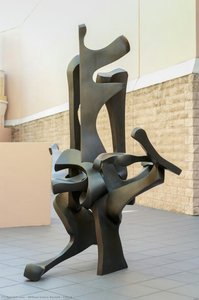
Barrett’s practice is defined by an uncompromising commitment to materiality, specifically through his use of reclaimed metals. By working with steel and iron, he engages in a process that is as much about environmental stewardship as it is about aesthetic exploration. He employs a sophisticated subtractive method, carefully manipulating and removing material to reveal the underlying structural truths of his subjects. This technique results in sculptures that possess an incredible textural complexity, inviting the viewer to touch the weathered surfaces that mimic geological formations.
The symbolism within his work often revolves around the synthesis of opposing forces:
- The Arch and the Bridge: Recurring motifs that suggest connection and the structural integrity of the natural world.
- Elemental Forces: The use of heavy, industrial materials to evoke the lightness of wind or the crushing weight of stone.
- The Search for Synthesis: A lifelong quest to merge the tactile, expressive gesture of free modeling with the precise, disciplined craft of welding metal sheets.
His mastery extends beyond steel into the realm of aluminum, where his work takes on a brighter, cleaner, and more horizontal character, reflecting the clarity of light. Whether he is working on massive installations that tower over thirty feet or intimate pieces designed for interior command, Barrett’s sculptures possess an empathetic quality. They do not merely occupy space; they transform it, demanding a high-level discussion of truth, beauty, and the enduring spirit of the earth.
Legacy and Historical Significance
As a central figure in the second generation of American metal sculptors, Barrett’s historical significance lies in his ability to move beyond the purely abstract toward a more symbolic, landscape-rooted expression. Drawing inspiration from masters such as Henry Moore, Rodin, David Smith, and Picasso, he integrated the lessons of modernism with a deeply personal connection to the American terrain. His work serves as a bridge between the industrial revolution's heavy materials and the contemporary era's ecological consciousness.
Today, the legacy of Bill Barrett is found in museums and private collections worldwide, standing as a testament to the power of transformation. He has successfully proven that even the most discarded, industrial materials can be reborn into works of profound grace. Through his hands, cold steel becomes a living landscape, and the heavy weight of metal becomes a soaring celebration of the natural world's eternal beauty.