A Master of Gothic Splendor: Pedro García de Benavarre
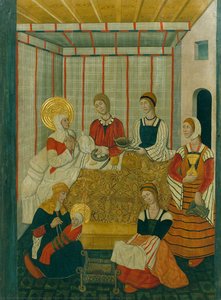
Pedro García de Benavarre, a name resonating through the annals of Spanish Gothic painting, remains an enigmatic figure whose artistry flourished in the mid-15th century. While precise biographical details are scarce, enough documentation exists to trace his movements and appreciate the profound impact he had on the artistic landscape of Aragon and Catalonia. Born sometime before 1445, likely within the Kingdom of Aragon, Benavarre’s career unfolded against a backdrop of shifting political alliances and burgeoning religious fervor. He first appears in historical records in Zaragoza around 1445, working in collaboration with Blasco Grañén, who is believed to have been his teacher. This early period saw their joint involvement in the altarpiece of Villarroya de Campo, offering a glimpse into Benavarre’s formative years and the foundational techniques he absorbed.
From Collaboration to Independent Vision
By 1452, Benavarre had established himself independently in his namesake town, Benabarre, undertaking commissions that allowed him to refine his unique style. A pivotal moment arrived in 1455 when he relocated to Barcelona, accepting a significant contract from the widow and son of Bernat Martorell, one of Catalonia’s most celebrated painters. The terms stipulated the completion of unfinished works left by Martorell and the acceptance of future commissions for five years. This association with Martorell's workshop was crucial; it exposed Benavarre to a different artistic tradition—one characterized by greater elegance, refined detail, and a more sophisticated use of color. However, the extent to which he fully integrated Martorell’s style remains debated, as Benavarre quickly developed a distinctive voice that blended Gothic traditions with emerging Renaissance influences. His work during this period includes the altarpieces of St. Clare of Assisi and St. Catherine of Alexandria for Barcelona Cathedral, showcasing his growing mastery of narrative composition and expressive figuration.
A Period of Wandering and Mature Style
The years following 1460 witnessed a period of considerable movement for Benavarre. He returned to Benabarre, where he continued to receive commissions from surrounding areas until approximately 1469. This phase is marked by an increasing confidence in his artistic vision and the creation of some of his most celebrated works. The Virgin Enthroned with Four Angels, now housed in the National Museum Art de Catalunya (often referred to as the *Virgen de Bellcaire*), exemplifies this maturity. Signed with a rare handwritten inscription, it reveals a delicate balance between the stylized forms of Gothic art and a nascent naturalism. The composition is characterized by its serene beauty, graceful figures, and rich color palette. Further commissions in Lleida during the 1470s, including work on altarpieces for Dominican monasteries, demonstrate his continued demand and versatility.
Legacy and Historical Significance
In 1481, Benavarre settled in Barbastro, where he remained until at least 1485, continuing to fulfill commissions for local churches. His final documented work involved painting an altarpiece for the church of San Francisco, a testament to his enduring career. Pedro García de Benavarre’s significance lies not only in the beauty and technical skill of his paintings but also in his role as a transitional figure bridging the Gothic and Renaissance periods in Spanish art. He skillfully synthesized the decorative elegance of International Gothic with emerging Italianate influences, creating a style that was both deeply rooted in tradition and open to innovation. His influence can be seen in the works of subsequent Aragonese painters, who adopted his refined techniques and expressive figuration. While he may not have achieved the widespread fame of some of his contemporaries, Benavarre’s contributions remain vital for understanding the evolution of Spanish painting during a period of profound artistic change. His altarpieces, scattered throughout Catalonia and Aragon, continue to captivate viewers with their serene beauty, intricate detail, and enduring spiritual power. His work is a testament to the skill and artistry of a master who helped shape the visual landscape of 15th-century Spain.