Yiannis Spyropoulos: A Visionary of Greek Modernism
Yiannis Spyropoulos (1912-1990) stands as a pivotal figure in the evolution of Greek art, bridging the gap between tradition and abstract expressionism. Born in Pylos, on the Peloponnese peninsula, his early life was deeply rooted in the landscape and mythology of his homeland – influences that would profoundly shape his artistic vision. Spyropoulos’s journey wasn't a straightforward ascent; it involved periods of intense study abroad, grappling with diverse artistic movements, and ultimately forging a uniquely personal style characterized by raw emotion, dynamic gestures, and an evocative engagement with the spirit of Greece.
His formal training began at the Athens School of Fine Arts in 1933, under the tutelage of masters like Spyridon Vikatos, Umberto Argyros, and Epameinondas Thomopoulos. This foundational period instilled a respect for classical forms and techniques, yet it was his subsequent sojourn to Paris in 1938 – funded by an Academy scholarship – that proved transformative. There, amidst the vibrant artistic ferment of the interwar years, he encountered the École Supérieure des Beaux-Arts, learning from Charles-François-Prosper Guérin, a key figure in the French avant-garde. This exposure to European modernism, particularly the dynamism and color palettes of Fauvism and early Cubism, laid the groundwork for his later stylistic explorations.
The Development of a Distinctive Style
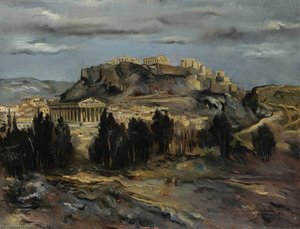
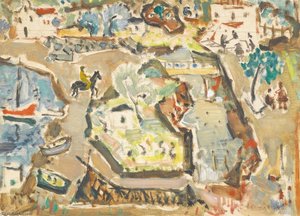
Spyropoulos’s artistic development wasn't linear; it involved a fascinating interplay of influences and experimentation. Initially, he explored Impressionistic techniques, capturing the beauty of the Greek landscape with delicate brushstrokes and luminous colors. However, during World War II, his work shifted towards a more nationalistic style, drawing inspiration from Byzantine iconography and traditional Greek motifs. This period saw him incorporate elements of religious symbolism and narrative into his paintings, reflecting a desire to connect with Greece’s rich cultural heritage.
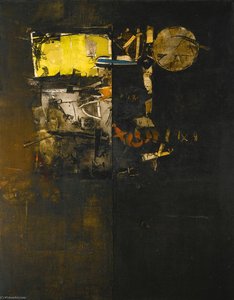
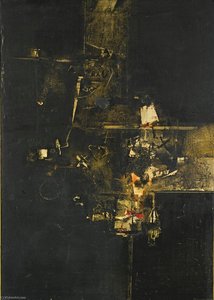
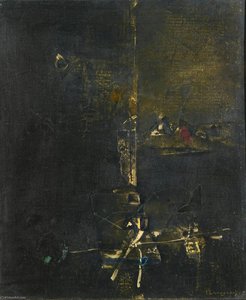
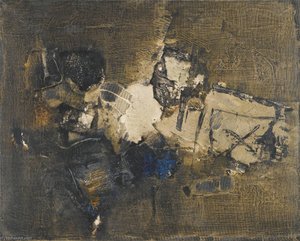
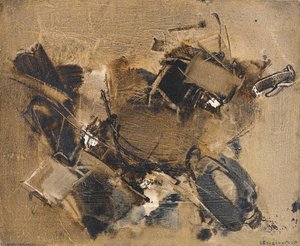
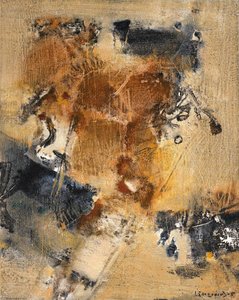
The post-war years witnessed a radical transformation in Spyropoulos's approach. He embraced abstraction, moving away from representational forms towards a more expressive language. This shift was fueled by his time in New York during the 1950s and 60s, where he encountered the burgeoning Abstract Expressionist movement. He began to utilize bold colors, gestural brushstrokes, and unconventional materials – including fabrics, sacks, and newspapers – to convey raw emotion and a sense of immediacy. His work became characterized by dynamic compositions, layered textures, and a palpable energy that resonated with the spirit of the age.
Key Works and Recognition
Several works stand out as particularly significant in understanding Spyropoulos’s artistic trajectory. “Anafiotika” (1958), a monumental canvas depicting the iconic cliffside village of Anafi, exemplifies his ability to capture both the beauty and the ruggedness of the Greek landscape. “Oracle,” created for the 1960 Venice Biennale, cemented his international recognition, showcasing his innovative use of color and texture. Other notable paintings include “Lyndos I” (1957), a vibrant depiction of the ancient town of Lindos, and "Ora No. 11" (1958), which demonstrates his mastery of layering and gestural brushwork.
Throughout his career, Spyropoulos received numerous accolades, including the UNESCO Prize at the Venice Biennale in 1960, the Gold Medal of the City of Belgium in 1961, and the Gottfried von Herder Prize in Vienna in 1978. His work was exhibited extensively throughout Europe and North America, solidifying his position as a leading figure in contemporary Greek art.
Legacy and Historical Significance
Yiannis Spyropoulos’s legacy extends far beyond the canvases he created. He played a crucial role in fostering a vibrant artistic community in Greece during a period of significant social and political change. His willingness to experiment with new techniques and materials, coupled with his deep connection to Greek culture and mythology, paved the way for future generations of artists. Spyropoulos’s work continues to be celebrated for its emotional intensity, dynamic energy, and unique vision – solidifying his place as a truly significant figure in the history of 20th-century art.
The Jannis & Zoe Spyropoulou Foundation, established shortly after his death, ensures that his artistic legacy will continue to be preserved and promoted for years to come. His paintings are held in major museums worldwide, testament to the enduring power and relevance of his work.