Utagawa Yoshimori: The Silent Observer of Yokohama’s Dawn
Born Sakuzō Taguchi in 1830, Utagawa Yoshimori emerged from the bustling artistic milieu of Edo Japan as a student of the celebrated Utagawa Kuniyoshi. Though often overshadowed by his mentor's monumental fame, Yoshimori carved out a distinctive niche within the vibrant landscape of Yokohama-e—the panoramic prints depicting the burgeoning port city and its surroundings. His life spanned a period of profound transformation, bridging the gap between the old, medieval traditions of Japan and the rapid modernization that followed the opening of the country to the West. Through his woodblock prints, he acted as a quiet chronicler of this era, leaving behind an enduring legacy of serene beauty and meticulous detail.
Yoshimori’s formative years were steeped in the rigorous artistic traditions of Japan's established circles, where he honed his skills under Kuniyoshi's watchful eye. This mentorship instilled in him a profound appreciation for capturing fleeting moments of nature and conveying emotion through subtle tonal variations—a hallmark of the Utagawa school that would subsequently permeate Yoshimori’s own oeuvre. The influence of Kuniyoshi extended beyond mere technique; it fostered a contemplative spirit, encouraging Yoshimori to observe the world with quiet reverence. While his contemporaries often sought the dramatic or the sensational, Yoshimori found greatness in the understated.
A Mastery of Stillness and Detail
Yoshimori's landscapes stand apart from many of his contemporaries due to their remarkable stillness and understated grandeur. Unlike the dynamic, often turbulent compositions favored by other artists of the period, Yoshimori’s works are characterized by a meticulous attention to detail—the precise rendering of foliage, the texture of rocks, and the translucent quality of water—creating scenes that invite prolonged contemplation. He frequently eschewed dramatic vistas or sudden storms, instead opting for tranquil depictions of mountains bathed in misty sunlight or serene riverside views populated by birdsong. This deliberate restraint reflects a broader artistic sensibility rooted in Zen Buddhism, emphasizing harmony and balance as core aesthetic principles.
< p>His prints frequently featured the natural world, particularly birds such as cranes, which served as powerful symbols of longevity and auspiciousness deeply ingrained in Japanese culture. Yoshimori skillfully captured the graceful movements of these creatures soaring against expansive skies, conveying not only visual beauty but a sense of spiritual continuity. His ability to blend the organic elements of nature with the emerging realities of a changing Japan allowed him to create works that felt both timeless and contemporary.The Witness to a Changing World
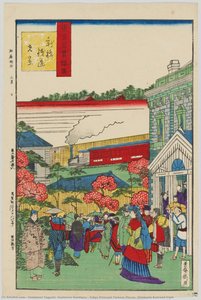
As the isolation of the Edo period crumbled, Yoshimori became a vital contributor to the Yokohama-e genre. These prints documented the influx of foreign people, technologies, and goods into the small enclave of Yokohama. Through his lens, we see the fascination of a nation encountering the "other"—the sight of Westerners, imported machinery, and the strange, new objects that arrived via the sea. This subject matter was the business of the day, yet Yoshimori approached these modern intrusions with his signature grace, integrating them into his compositions without sacrificing the aesthetic tranquility of his landscapes.
Beyond the port of Yokohama, Yoshimori also contributed to significant series centered on the Tokaido Road, the vital eastern sea road connecting Edo to Kyoto. His work in series such as The Scenic Places on the Tokaido (1863) and Calligraphy and Pictures along the Fifty-three Stations (1872) captured both the pomp of imperial processions and the quiet beauty of the Japanese countryside. His historical significance lies in this duality: he was an artist capable of honoring the ancient, poetic traditions of his ancestors while simultaneously documenting the technological and social shifts that would define modern Japan. In the delicate lines of his woodblock prints, the transition from a closed world to a globalized one is captured with unparalleled sensitivity.