



A Haunting Symphony of Faith and Mortality
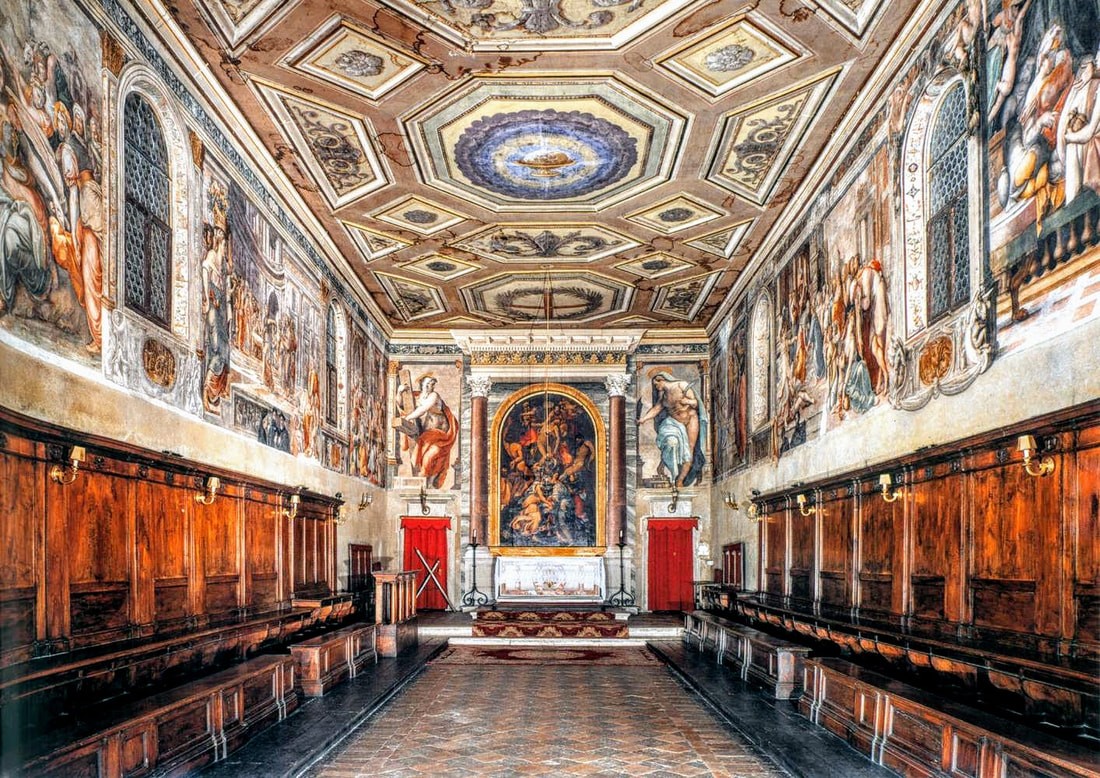
Nestled within the historic Ripa district of Rome, the Oratory of San Giovanni Decollato stands as a profound architectural paradox, where the sublime beauty of the Renaissance meets the visceral shadows of Roman justice. To enter this sacred space is to step into a realm where the ethereal and the earthly collide. The structure itself, built upon the foundations of much older ecclesiastical ruins, embodies the transition from the balanced proportions of the High Renaissance to the more restless, dramatic energy of Mannerism. Its walls do not merely enclose a room; they hold a silent dialogue between the spiritual aspirations of a dedicated confraternity and the grim reality of the executions that once defined this corner of the city.
The true soul of the Oratory resides in its breathtaking upper reaches, where a magnificent cycle of frescoes breathes life into the narrative of Saint John the Baptist. Executed around 1540, these works represent a pinnacle of Mannerist mastery, featuring the hands of Francesco Salviati, Jacopino del Conte, and Pirro Ligorio. As one gazes upward, the eye is ensnared by Salviati’s sophisticated use of chiaroscuro, where dramatic shifts in light and shadow create an almost tactile sense of depth. The compositions are intentionally complex, utilizing the elongated forms and unsettling perspectives characteristic of the era to evoke a sense of divine tension. The vibrant hues and meticulous anatomical details provided by Ligorio and Del Conte transform the ceiling into a celestial stage, pulling the viewer into a swirling vortex of religious devotion and artistic virtuosity.
Yet, the Oratory offers an experience that is uniquely unsettling, distinguishing itself from any other Roman chapel through its collection of artifacts born from tragedy. Beneath the splendor of the frescoes lies a sobering museum of mortality. The Oratory houses a haunting array of objects used in the administration of death during the 16th century, including instruments of torture and anatomical specimens that serve as stark reminders of the human condition. Perhaps most poignant is the presence of the basket once used to hold the severed head of Beatrice Cenci, a figure whose tragic execution remains etched in Roman legend. This juxtaposition of high art and historical horror creates an atmosphere of profound reflection, making the Oratory a site where the beauty of human creativity confronts the inescapable gravity of death.
For the art historian, the collector, or the designer seeking depth beyond mere decoration, the Oratory of San Giovanni Decollato offers a masterclass in emotional resonance. It is a place where the charitable mission of the Archconfraternity—which once provided spiritual solace to those awaiting their final moments—is physically manifested in the very fabric of the building. The legacy of this institution is not found merely in its pigments or stones, but in its ability to bridge the gap between the sacred and the profane, offering a singular, immersive encounter with the enduring power of faith amidst the shadows of history.




