 Ver en contexto
 Enviar
 Compartir
 Detalles

 Descargar
 Similares
 Radiografía
 Presentación de diapositivas
Salmacis et Hermaphrodite


 Ver más
Giclée / Impresión de arte
Impresiones giclée o en lienzo de calidad de museo con producción rápida y opciones de acabado flexibles. ( Comprar pintura hecha a mano Comprar imagen)




P118B $10

P118H $10

P118W $10

P438Z $10

P508JH $12

P508YH $12

P805H $10

P805Z $10

P919BZ $10

P919G $10

P919XJ $10

P959ZH $10

P968JZ $12

W106C $8

W218G $10

W218JH $8

W218Y $10

W307PJ $10

W316G $10

W316PJ $8

W316Y $10

W398PJ $8

W4111J $10

W500HY $15

W500JH $15

W692G $12

W849H $8

W940BG $15

W953PJ $8




Elija entre nuestros tamaños predefinidos que respetan las proporciones originales de la obra.

Puede introducir sus propias dimensiones para adaptarse a un marco o espacio específico. Si el tamaño seleccionado no coincide con las proporciones de la imagen original, recortaremos la obra de arte o extenderemos la imagen con un borde con efecto espejo o de color sólido. Se enviará una maqueta digital para su aprobación antes de que comience la producción.
Tenga en cuenta que la vista previa en pantalla no refleja el recorte o la extensión real. Solo la maqueta mostrará con precisión la composición final.
Aunque existen tamaños personalizados, recomendamos seleccionar una dimensión de la lista predefinida para preservar las proporciones originales.
Envío a todo el mundo () en 2 semanas en lugar de las 4/5 semanas estándar. (6 septiembre)

Envío exprés gratuito a todo el mundo

Lienzo de lino de alta calidad

Seguro de envío total

Garantía de reembolso de impuestos aduaneros

Garantía de fidelidad cromática exacta

Política de devolución de 100 días (solo por defectos)

Garantía de devolución del 100% del dinero

Descuento por cantidad
 La opción de vidrio solo está disponible en tamaños inferiores a 110 cm.

Salmacis et Hermaphrodite
Giclée / Impresión de arte
Dimensiones de la reproducción
-


Precio total final
$ 62
Salmacis et Hermaphrodite: A Baroque Echo of Mythic Transformation
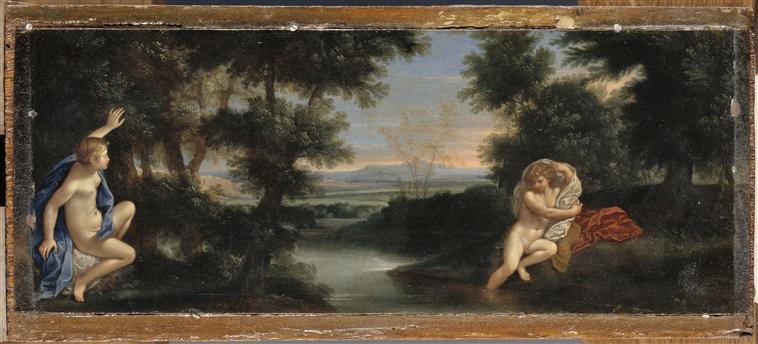
Francesco Albani’s “Salmacis et Hermaphrodite,” housed in Dulwich Picture Gallery, stands as a testament to the grandeur and emotional intensity characteristic of Baroque art. Painted around 1650, this stunning studio piece captures a pivotal moment from Ovid's Metamorphoses – the transformative union of Salmacis, a nymph longing for beauty, and Hermaphroditus, a god who seeks human form. Albani’s masterful execution elevates the mythological narrative into an unforgettable visual experience.- Subject Matter & Narrative: The painting depicts Salmacis and Hermaphroditus's fateful encounter as they approach each other across a tranquil lake landscape. According to myth, Salmacis wished for Hermaphroditus’s masculine attributes, resulting in their bodies merging into a single being – half-male, half-female – symbolizing the pursuit of perfection and transcendence.
- Style & Technique: Albani adheres closely to Baroque principles, prioritizing dramatic lighting and dynamic composition. The chiaroscuro technique—the skillful manipulation of light and shadow—creates an ethereal atmosphere, highlighting the figures’ muscular forms and emphasizing their emotional expressions. Layers of oil paint contribute to a rich textural surface that captures the subtle nuances of color and form.
- Composition & Perspective: The horizontal format emphasizes the expansive landscape, mirroring the scale of the mythological drama unfolding before us. Linear perspective guides the viewer's gaze towards a vanishing point in the distance, reinforcing the sense of depth and creating an illusionistic space that draws the eye into the scene.
- Color Palette & Symbolism: The palette is dominated by earthy hues—greens representing nature’s fecundity and browns conveying stability—contrasted with delicate flesh tones on the figures. The subtle gradient in the sky evokes twilight, symbolizing transition and hinting at the transformative process occurring between Salmacis and Hermaphroditus.
- Emotional Impact: Albani's portrayal conveys a palpable sense of longing and desire. Although facial expressions are somewhat obscured by stylistic conventions, the figures’ gestures communicate their yearning for unity and beauty—a timeless theme resonating with viewers across centuries.
- Hermaphrodite: Wikipedia Search – Provides a scientific overview of hermaphroditism and its biological significance.
- Salmacis et Hermaphrodite: Albani in Dulwich Picture Gallery – Offers detailed information about the painting's history, provenance, and artistic merits.
- File:Albani, Francesco - Salmacis and Hermaphrodite - Google Art Project: Wikimedia Commons – Presents high-resolution images of the artwork and related resources for scholarly study.
- Print | British Museum: British Museum – Provides context on the painting's artistic influences and its place within the broader canon of Baroque art.
Obras relacionadas
Biografía del artista
Albani Francesco, también conocido como l'albane, fue un destacado pintor italiano nacido en 1578 y activo hasta su muerte en 1660. Fue una figura clave en el desarrollo de la pintura barroca en Italia, particularmente en Roma.
Primeros años y formación
Francesco Albani nació en Bolonia, Italia, en una familia de artistas. Su padre, Daniele Albani, era pintor, y su tío, Giovanni Paolo Cavagna, fue un artista renombrado. La formación temprana de Francesco tuvo lugar en el estudio de Denzio Ferrari, donde aprendió los fundamentos de la pintura. Más tarde, se trasladó a Roma para estudiar bajo la guía de Guidobaldo Gandolfi.Carrera artística
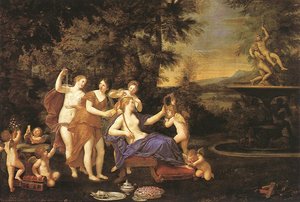
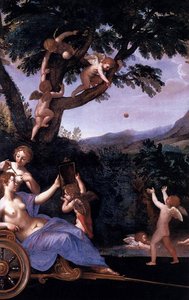
La carrera artística de Albani estuvo marcada por su estilo único, que fusionaba elementos del arte barroco y el clásico. Era conocido por sus hermosas y delicadas representaciones de escenas mitológicas y bíblicas. Una de sus obras más famosas es El Tocador de Venus, una pintura que exhibe su habilidad para capturar la belleza de la forma humana. Algunas de las obras notables de Albani incluyen:- El Bautismo de Cristo, una pintura que demuestra su capacidad para transmitir emoción y drama.
- San Sebastián, una obra que resalta su maestría con la luz y la sombra.
- La Virgen y el Niño con San Juan Bautista, una pintura que muestra su habilidad para capturar los matices de la expresión humana.
Influencia y legado
La influencia de Albani en el desarrollo de la pintura barroca en Italia fue significativa. Fue uno de los primeros artistas en introducir el uso del claroscuro, una técnica que enfatiza el contraste entre la luz y la oscuridad. Su obra también tuvo un impacto en el desarrollo de la pintura paisajística, ya que a menudo incorporaba paisajes naturales en sus composiciones. Hoy en día, las pinturas de Albani se pueden encontrar en varios museos, incluido el Museo del Louvre en París, donde está expuesto su El Tocador de Venus. Su obra también ha sido presentada en ArtsDot.com, donde los entusiastas del arte pueden aprender más sobre su vida y logros artísticos.Conclusión
Francesco Albani fue un pintor talentoso que dejó una marca indeleble en el mundo del arte. Su estilo único, que fusionaba elementos del arte barroco y clásico, continúa inspirando a artistas hoy en día. A través de su obra, podemos apreciar la belleza y el drama de la forma humana, así como la importancia de la luz y la sombra para crear una sensación de profundidad y emoción. Para más información sobre la vida y obra de Albani, visite ArtsDot.com o consulte su biografía en Wikipedia.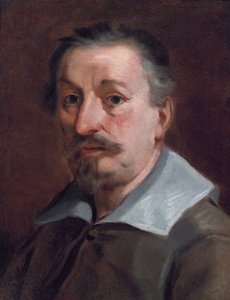
Francesco Albani (L'Albano)
1578 - 1660 , Italia
Artículos relacionados

Barroco Sublime: 10 Obras Maestras que Definieron una Época |
Descubre las 10 obras maestras del Barroco que marcaron una época. Caravaggio, Bernini y Velázquez cobran vida en . Reproducciones de arte de calidad museo para decorar tu hogar con elegancia. ¡Explora la colección online!

Drama Barroca: Llevando la Grandeza y la Emoción a los Interiores Contemporáneos
Descubre cómo el drama y la grandeza del arte barroco pueden transformar tus interiores. Guía experta, inspiración y reproducciones de alta calidad en .

The Dramatic Flourish: Exploring the Baroque Movement's Enduring Legacy in Art History
Explore the dramatic world of Baroque art! Discover iconic artists like Caravaggio & Rubens, defining techniques, and its lasting impact on art history. Expert insights for collectors & enthusiasts at ArtsDot.

The Visceral Stage: Exploring Dramatic Narratives & Emotional Intensity in Baroque Art
Explore the dramatic world of Baroque art! Discover iconic masters like Caravaggio & Rembrandt, their techniques, and the movement's lasting impact. Expert insights for collectors & enthusiasts at ArtsDot.
Theatricality & Triumph: Baroque Drama in Painting & Sculpture
Explore the dramatic world of Baroque art! Discover its history, defining characteristics, & lasting influence on painting & sculpture. Expert insights into Caravaggio, Zurbarán, and Bernini – plus high-quality reproductions at ArtsDot.