 Ver en contexto
 Enviar
 Compartir
 Detalles

 Descargar
 Similares
 Radiografía
 Presentación de diapositivas
Los trabajos de Persiles y Sigismunda


 Ver más
Giclée / Impresión de arte
Impresiones giclée o en lienzo de calidad de museo con producción rápida y opciones de acabado flexibles. ( Comprar pintura hecha a mano Comprar imagen)




P118B $10

P118H $10

P118W $10

P438Z $10

P508JH $12

P508YH $12

P805H $10

P805Z $10

P919BZ $10

P919G $10

P919XJ $10

P959ZH $10

P968JZ $12

W106C $8

W218G $10

W218JH $8

W218Y $10

W307PJ $10

W316G $10

W316PJ $8

W316Y $10

W398PJ $8

W4111J $10

W500HY $15

W500JH $15

W692G $12

W849H $8

W940BG $15

W953PJ $8




Elija entre nuestros tamaños predefinidos que respetan las proporciones originales de la obra.

Puede introducir sus propias dimensiones para adaptarse a un marco o espacio específico. Si el tamaño seleccionado no coincide con las proporciones de la imagen original, recortaremos la obra de arte o extenderemos la imagen con un borde con efecto espejo o de color sólido. Se enviará una maqueta digital para su aprobación antes de que comience la producción.
Tenga en cuenta que la vista previa en pantalla no refleja el recorte o la extensión real. Solo la maqueta mostrará con precisión la composición final.
Aunque existen tamaños personalizados, recomendamos seleccionar una dimensión de la lista predefinida para preservar las proporciones originales.
Envío a todo el mundo () en 2 semanas en lugar de las 4/5 semanas estándar. (25 agosto)

Envío exprés gratuito a todo el mundo

Lienzo de lino de alta calidad

Seguro de envío total

Garantía de reembolso de impuestos aduaneros

Garantía de fidelidad cromática exacta

Política de devolución de 60 días (solo por defectos)

Garantía de devolución del 100% del dinero

Descuento por cantidad
 La opción de vidrio solo está disponible en tamaños inferiores a 110 cm.

Los trabajos de Persiles y Sigismunda
Giclée / Impresión de arte
Dimensiones de la reproducción
-


Precio total final
$ 62
Descripción de la pieza
Los Trabajos de Persiles y Sigismunda: Un Estudio Sobre la Última Obra Magistral de Cervantes
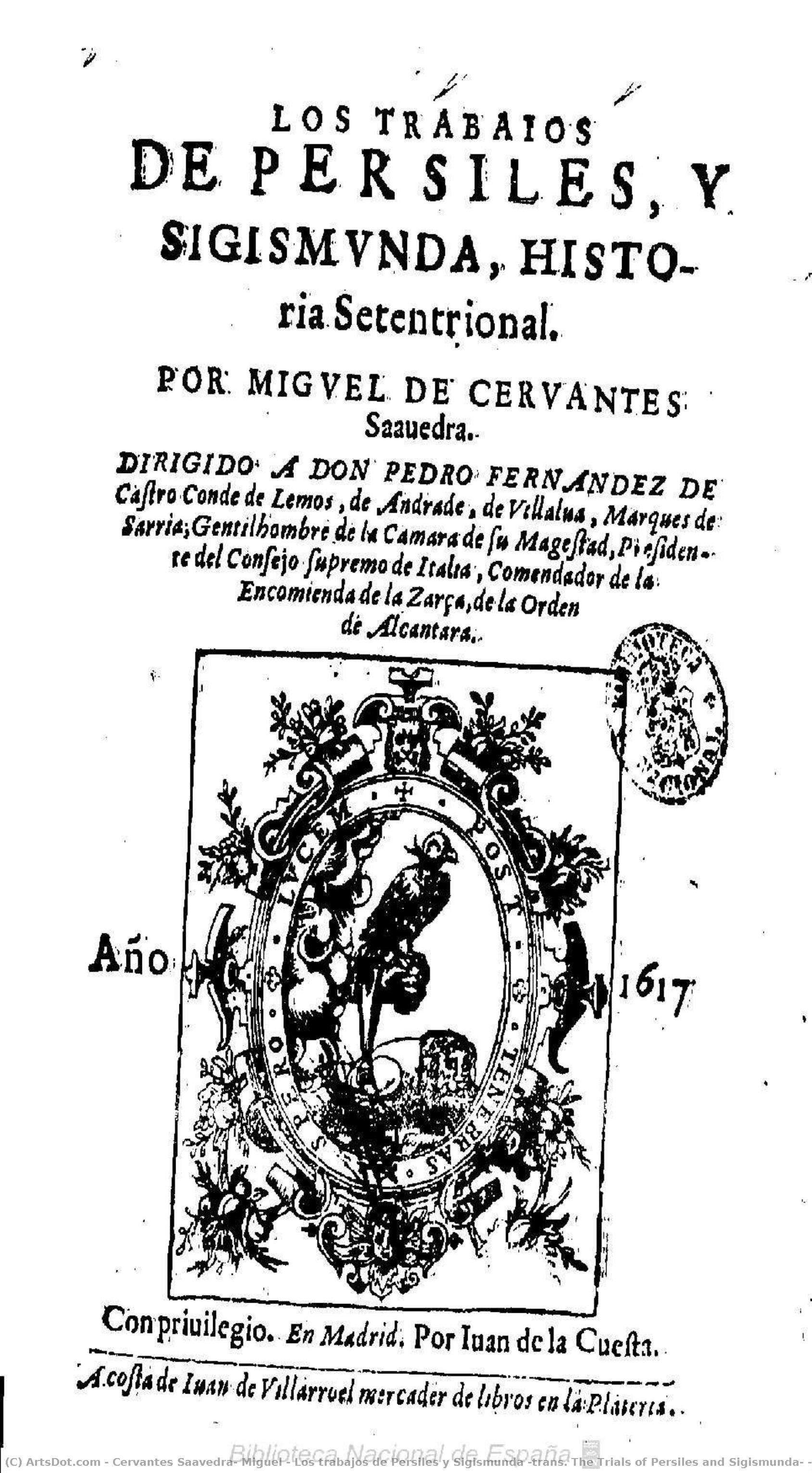
La Biblioteca Nacional de España alberga una ejemplar reproducción de *Los trabajos de Persiles y Sigismunda*, una obra que encapsula el espíritu tardío del escritor español Miguel de Cervantes Saavedra (1547-1616). Más allá de una simple narración histórica, este libro representa un punto culminante en la trayectoria artística de Cervantes, reflejando su maestría técnica y profundísima comprensión de las complejidades humanas. Esta publicación, fechada en 1617, marca el cierre de una etapa creativa excepcional que había comenzado siglos antes con *El ingenioso Hidalgo Don Quijote*, estableciendo un nuevo paradigma para la novela occidental.- Estilo Literario: Cervantes continúa explorando temas centrales como la ilusión y la realidad, pero ahora con una sensibilidad más madura y una mirada crítica hacia las convenciones sociales de su época. La obra se caracteriza por una prosa elegante y rica en imágenes sensoriales que evocan el ambiente español del siglo XVII.
- Técnica Imprenta: El libro fue producido mediante impresión litográfica, una técnica innovadora para la época que garantizó una calidad excepcional de imagen y texto. Los detalles minuciosos de los dibujos originales fueron reproducidos con precisión, ofreciendo una experiencia visual impresionante para el lector contemporáneo.
- Contexto Histórico: *Los trabajos de Persiles y Sigismunda* fue escrito en un período marcado por conflictos religiosos y políticos, como la Guerra Española contra Inglaterra y las tensiones entre el Imperio Español y otras potencias europeas. Cervantes abordó estos temas con una habilidad sorprendente, reflejando la inquietud intelectual del tiempo y ofreciendo una visión compleja de la sociedad española de aquel siglo.
Obras relacionadas

![Autograph Statement Requesting That The Guarantee Provided Be Considered Sufficient (biblioteca Nacional De España)\n\n[page 1] — Miguel De Cervantes Saavedra](/media/artworks/images-thumb/be/4d/be4d8356b5c62cf26a2aac9cd48fa43b.jpg)
![Vida De Miguel De Cervantes Saavedra (life Of Miguel De Cervantes Saavedra). Libro V De La Edición De Don Quijote (biblioteca Nacional De España) [7] — Martín Fernández De Navarrete, Arte Académico](/media/artworks/images-thumb/8c/b6/8cb67a4dd450447373a546c8dd039e57.jpg)
![La Verdadera Patria De Miguel De Cervantes (miguel De Cervantes’s True Homeland) (biblioteca Nacional De España) [4][fol.1] — Pedro José García Balboa, Renacimiento Barroco Rococó](/media/artworks/images-thumb/a6/d8/a6d842058b3ffb23732e0ff43fd89aac.jpg)
Biografía del artista
Miguel de Cervantes Saavedra: The Architect of Modern Literature
Miguel de Cervantes Saavedra (1547-1616) stands as an unparalleled figure in the annals of literature, rightfully crowned as Spain’s greatest writer and arguably one of the world's most influential novelists. His magnum opus, *Don Quixote*, transcends mere storytelling; it fundamentally reshaped the genre, establishing itself as the progenitor of the modern novel and securing its place amongst the literary titans of all time—a testament lauded by authors like Tolstoy and Dickens themselves. Born in Alcalá de Henares, Spain, Cervantes’s life unfolded amidst considerable hardship and obscurity, a stark contrast to the enduring legacy he bequeathed upon humanity.Early Life & Education: A Foundation of Dreams
Cervantes received his initial education at Universidad Complutense, where he studied theology—a path that ultimately proved unsuccessful for him due to financial constraints. Despite facing difficulties securing stable employment, he honed his skills as a soldier and traveled extensively throughout Europe during the turbulent years of the Thirty Years’ War, experiences which would profoundly shape his worldview and fuel his imaginative prowess. These formative journeys instilled in him a keen observation of human behavior and fueled his fascination with diverse cultures—elements that would later permeate his literary creations. The family history begins with the author’s grandfather, Juan de Cervantes (b. 1490), a lawyer who at one time (1545-6) administered the estates of the duke de Osuna, and resided later at Cordova, where he died about 1555. Cervantes’ father was Rodrigo de Cervantes, an apothecary-surgeon, who married Leonor de Cortinas in 1540 or 1541. The children of this marriage were Andrés (b. 1543), Andrea (b. 1544), Luisa (b. 1546), Miguel (1547-1616), Rodrigo (b. 1550), Magdalena (b. 1554) and Juan (of whom nothing is known beyond the mention of him in his father’s will). It may be assumed that Rodrigo was running from debts that he had accumulated over the years and, above all, from his past in prison.Literary Beginnings & Early Works: Seeds of Genius
Cervantes began his literary career with poems and plays—often overshadowed by his later fame—demonstrating a versatility that foreshadowed his future accomplishments. However, it was *La Novela Ejemplar* (*Concerning Notable Novels*) which garnered initial recognition, showcasing his mastery of prose style and exploring themes of chivalry and idealism. Tragically, many of these early works vanished into obscurity, leaving only fragments to tantalize scholars. These pioneering narratives established Cervantes as a master of psychological realism—a characteristic that would define *Don Quixote* and solidify his reputation as one of Spain’s foremost writers.Don Quixote: A Revolution in Narrative Form
Published in two parts between 1605 and 1615, *Don Quixote* irrevocably altered the conventions of storytelling. Departing from the episodic romances prevalent at the time, Cervantes crafted a sprawling narrative characterized by psychological depth, realistic portrayal of characters, and intricate plot development—elements that would become hallmarks of the modern novel. The tale chronicles the delusional adventures of Alonso Quijano, an aging nobleman who embarks on a quest to revive chivalric ideals after indulging in fantastical tales of knights errant. Through Sancho Panza’s pragmatic foil, Cervantes deftly juxtaposes idealism and reality, prompting readers to contemplate the nature of illusion and perception. The novel's innovative structure—featuring multiple interwoven storylines and shifting perspectives—challenged established literary traditions and paved the way for countless subsequent works.- Themes & Symbolism: *Don Quixote* delves into profound philosophical questions concerning human ambition, disillusionment, and the importance of imagination. The windmill obsession serves as a potent symbol of Quijano’s futile pursuit of unattainable goals—a motif that resonates across centuries and continues to inspire interpretations.
- Renaissance & Baroque Influences: Cervantes's work embodies both Renaissance humanist ideals and Baroque stylistic flourishes. His meticulous attention to detail, combined with vivid descriptions of landscapes and characters, reflects the Baroque fascination for grandeur and emotion—a deliberate contrast to the restrained aesthetic sensibilities of earlier periods.
Legacy & Historical Significance: An Enduring Influence
Cervantes’s influence extends far beyond the literary realm. His novel established a new standard for narrative complexity and psychological realism, shaping subsequent generations of writers and cementing his position as a cornerstone of Western literature. More than simply recounting a fantastical adventure, *Don Quixote* offered a nuanced critique of societal values and explored the human condition with unparalleled sensitivity—a timeless masterpiece that continues to captivate audiences worldwide. His enduring fame is reflected in the phrase “the language of Cervantes,” signifying his indelible mark on Spanish culture and demonstrating the profound impact of his creative vision. Authors such as Dickens, Tolstoy, Kafka, and Márquez acknowledged Cervantes’s monumental contribution to literature, citing *Don Quixote* as a formative influence on their own artistic endeavors.- Influence on Subsequent Writers: Cervantes's groundbreaking narrative techniques—such as metafiction and unreliable narration—inspired writers across Europe and America to experiment with new forms of storytelling.
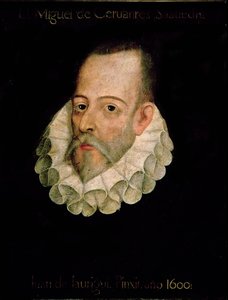
Miguel de Cervantes Saavedra
1547 - 1616 , España
Datos clave
- Artistic Movement Or Style: Renacimiento & Barroco
- Artists Or Movements Influenced By This Artist: ['Romanticismo']
- Artists Who Influenced This Artist: ['William Shakespeare']
- Date Of Birth: 29 septiembre 1547
- Date Of Death: 22 abril 1616
- Full Name: Miguel de Cervantes Saavedra
- Nationality: Español
- Notable Artworks: ['Don Quixote']
- Place Of Birth: Alcalá de Henares, España
Artículos relacionados
Rafael de Penagos: A Study in Spanish Portraiture & Artistic Identity
Explore the life & art of Rafael de Penagos, a leading Spanish Art Deco illustrator. Discover his iconic 'Penagos Woman', commercial work, and lasting legacy. Learn about this pivotal figure in 20th-century Spanish art history.

The Golden Age Reforged: Dramatic Realism & Religious Zeal in Spanish Baroque Art
Explore the dramatic world of Spanish Baroque art! Discover masters like Zurbarán & the powerful influence of religious zeal on painting techniques – a guide for collectors and enthusiasts.
José Gutiérrez Solana: A Chronicle of Spanish Society Through Expressionist Vision
Explore the captivating world of José Gutiérrez Solana, a pivotal Spanish Expressionist painter. Discover his haunting depictions of early 20th-century Spain, influenced by Goya & El Greco. Learn about his key works and lasting legacy.
Manuel Benedito Vives: A Study of Light, Color & Emotional Resonance in Contemporary Spanish Painting
Explore the captivating world of Manuel Benedito Vives, a celebrated Spanish painter influenced by Sorolla. Discover his masterful portraits, luminous landscapes & enduring legacy – a favorite of the Spanish Royal Family. Art collectors will appreciate this in-depth study.
Las 25 Obras Maestras del Prado: Arte Español e Inspiración para tu Hogar
Descubre las 25 obras maestras del Museo del Prado: Velázquez, Goya, El Greco y más. Explora la historia, técnica y belleza de cada cuadro español. Encuentra reproducciones de arte exclusivas e inspira tu hogar con ArtsDot.com.