Menú
Asesoría de arte gratuita
Ver en contextoVer en contexto Vista previa en RAVista previa en RA Comprar impresión Comprar impresiónComprar imagen Comprar imagen EnviarEnviar
DetallesDetalles Añadir a favoritos Añadir a favoritos DescargarDescargar SimilaresSimilares RadiografíaRadiografía Presentación de diapositivasPresentación de diapositivas

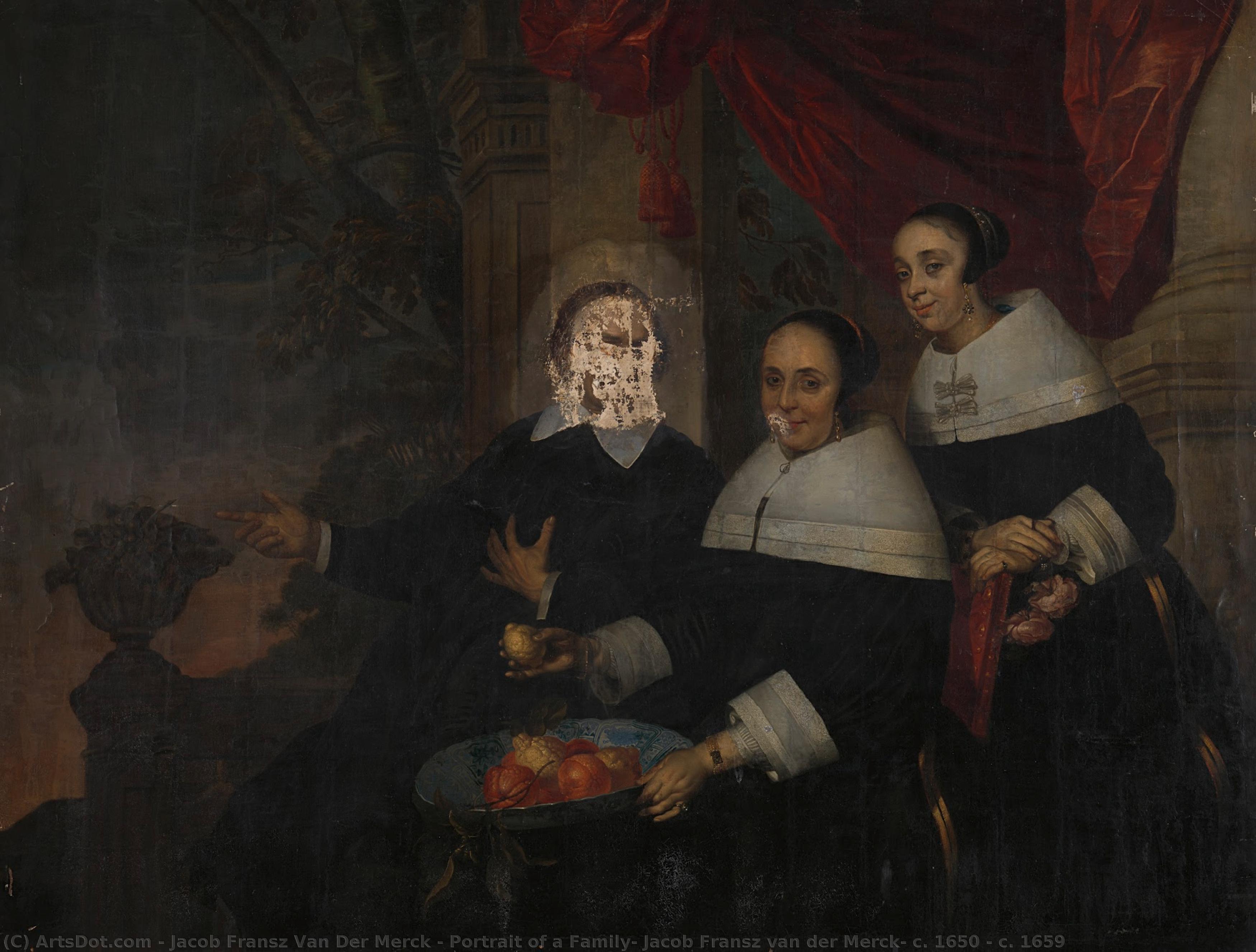
Portrait of a Family, Jacob Fransz van der Merck, c. 1650 - c. 1659

  • Fecha de creación1659
  • Dimensiones150.0 x 195.0 cm

Discover Jacob Franz van der Merck's Dutch Golden Age portraits & genre scenes. Explore his captivating works from the 17th century, a master of realism and storytelling.

Reproducción al óleo hecha a mano

Óleo sobre lienzo pintado a mano en el tamaño y marco de su elección, realizado por encargo por nuestros artistas. (Comprar impresión Comprar impresiónComprar imagen Comprar imagen)

Estándar
a medida
CM
INCH

Elija entre nuestros tamaños predefinidos que respetan las proporciones originales de la obra.

ancho
altura

Puede ingresar sus propias dimensiones para adaptarse a un marco o espacio específico. Si el tamaño seleccionado no coincide con las proporciones de la imagen original, recortaremos la obra o extenderemos la pintura con elementos adicionales pintados a mano. Se le enviará una maqueta digital para su aprobación antes de comenzar la producción.
Tenga en cuenta que la vista previa en pantalla no refleja el recorte o la extensión reales. Solo la maqueta mostrará con precisión la composición final.
Si bien existen tamaños personalizados, recomendamos seleccionar una dimensión de la lista predefinida para preservar las proporciones originales.

Ejemplos de lo que se puede personalizar: Reemplace el rostro con una foto del cliente; Agregue una mascota (por ejemplo, cambie un gato por un perro); Incluya un mensaje oculto en el fondo; Cambie el paisaje o los elementos del fondo.
Tras realizar el pedido, el equipo de ArtsDot.com enviará un correo electrónico al cliente para solicitar instrucciones y proporcionarle una vista previa del boceto.

Envío a todo el mundo () en 3-4 semanas en lugar de las 5 semanas estándar. (4 septiembre). Sin comprometer la calidad.

why_choose_icon
Envío exprés gratuito a todo el mundo
why_choose_icon
Lienzo de lino de alta calidad
why_choose_icon
Seguro de envío total
why_choose_icon
Garantía de reembolso de impuestos aduaneros
why_choose_icon
Garantía de fidelidad cromática exacta
why_choose_icon
Política de devolución de 60 días (solo por defectos)
why_choose_icon
Garantía de devolución del 100% del dinero
why_choose_icon
Descuento por cantidad

Precio total

$ 263

reproduction

Portrait of a Family, Jacob Fransz van der Merck, c. 1650 - c. 1659

Técnica de reproducción

Dimensiones de la reproducción

-

Precio total final

$ 263

This family portrait by Jacob van der Merck was one of two paintings that Adriaan Justus Enschedé, city archivist of Haarlem, presented to the forerunner of the Rijksmuseum in December 1874.6 The Nederlandsch Museum voor Geschiedenis en Kunst was still being governed at the time by the Commission of State Advisers for Monuments of History and Art, of which Enschedé had become a member shortly before. The donation was discussed at a committee meeting on 14 January 1875,7 and according to the minutes Enschedé had discovered both works in Amsterdam. The portrait by Van der Merck ‘lay flat on the floor to prevent peat getting into the cracks in the floor’, and the other painting, which was a copy after Abraham Liedts’s likeness of Admiral Pieter Florisz,8 was wrapped around the slabs of peat. Unfortunately, there is no mention of the location, so the earlier provenance of the pictures cannot be traced.9 Van der Merck’s canvas was thus in a very battered condition when it entered the Nederlandsch Museum and it was then probably restored. Nothing was said about its state when it was transferred from The Hague to Amsterdam in 1885.10 However, there is a note in the Rijksmuseum’s inventory book that it was partly overpainted. Today the man’s head has disappeared completely. It was very probably decided to rectify the previous intervention but that was done too radically.11 Despite its sorry condition, the work does give a reasonable idea of Van der Merck’s qualities as a portraitist. The balustrade and other architectural details suggest that the family is on the terrace of a building resembling a pavilion. The married couple are seated, with a younger woman, probably a daughter, standing on the right. It was not uncommon for companies to be depicted outdoors surrounded by greenery in the seventeenth century, but in the 1650s artists like Bartholomeus van der Helst increasingly placed them on a terrace with columns and other structural elements in the background, sometimes combined with a drapery. Anthony van Dyck had been using motifs like that in his portraits since the 1620s. The vertical shape behind Van der Merck’s male sitter might have been intended to be a circular pillar like the one in the top right corner, but it is no longer clearly distinguishable. Although the original effect may have been spoiled by wear, a clumsy handling of architectural details is also found in Van der Merck’s 1660 likeness of Willem van der Rijt and his family.12 There, too, he included a drapery with tassels, and judging by a painting he made of the governors of the Leiden Loridan almshouse it was a favourite device of his in group portraits.13 He also employed it in still lifes from time to time.14 The man shown here is using his right hand to indicate or activate something outside the painting. It would not have been the couple’s children, as is the case in Van der Merck’s far larger family portrait of 1653 in the Frans Hals Museum in Haarlem.15 Although there is no cusping visible, indicating that the picture may have been cut down,16 it is not certain that the composition has indeed been cropped. At any rate, the position of the signature on the cornice of the pillar does not give the impression that the canvas has been substantially trimmed on the left, the side the man is pointing at. According to the transfer list of 1885, the painting bears the year ‘1654’.17 That was adopted at first in the museum’s inventory book but later changed to ‘165.’, which is how it was catalogued in 1976.18 Not the slightest trace of any date can now be seen. Overzealous cleaning has removed it entirely, along with the last four letters of the signature. However, the reported year of 1654 would fit in well with the women’s dresses, especially the starched, lace-trimmed falling whisk collars and the wide, short cylindrical cuffs.19 If the date was read correctly at the time, the work is from the artist’s Hague period. The seated woman has a blue-and-white bowl in her lap filled with citrus fruit and is holding a lemon in her right hand, which could be a reference to marital fidelity in this context.20 Since such products were very expensive at the time, their combination with the dish of Chinese porcelain proclaims the wealth of the patron.21 Van der Merck’s talents for still lifes would have come in handy here. Richard Harmanni, 2023 See Key to abbreviations, Rijksmuseum painting catalogues and Acknowledgements

Biografía del artista

early life and training

jacob fransz van der merck, a prominent dutch old masters painter, was born in 1610 in 's-gravendeel, netherlands. little is known about his early life, but it is assumed that he received training in the vicinity of delft, given his enrollment in the delft guild of st luke under the name jacob fransz van sgravendeel in 1628.

artistic career

van der merck's artistic career is marked by his contributions to various genres, including portraits, genre scenes, and still-lifes. his work has been offered at auction multiple times, with realized prices ranging from 1,731 usd to 191,964 usd. notably, his painting "portrait of a lady and a gentleman as venus and adonis" sold for 191,964 usd at bonhams new bond street in 2011.

notable works and collaborations

* portrait of a young girl (dutch golden age, oil on canvas) * collaboration with bartholomeus van bassen on the restoration of paintings in 1650 * commissioned portraits for the city of leiden, including likenesses of captains of the civic guard in 1657

museums and collections

* rijksmuseum, amsterdam (features a collection of van der merck's paintings) * leiden, museum de lakenhal (houses extant works, including portraits of governors of the loridan almshouse)

legacy and death

van der merck died in leiden in september 1664 and was buried in the pieterskerk. his legacy is preserved through his numerous paintings, which can be found in various museums and collections, including those featured on https://ArtsDot.com, a platform providing excellent reproduction prints of masterpieces.
  • view van der merck's artwork on https://ArtsDot.com/@/jacob franz. van der merck
  • explore more dutch old masters painters on /en/art/list/
  • discover the rijksmuseum's collection on https://www.rijksmuseum.nl/nl/collectie/sk-a-853/catalogus-entry
important note: this article is based on available information and may be subject to updates as more data becomes available.
jacob franz. van der merck

jacob franz. van der merck

1610 - 1664 , Netherlands

Datos clave

  • Artistic Movement Or Style: Caravaggism
  • Artists Or Movements Influenced By This Artist: ['Baroque']
  • Artists Who Influenced This Artist: ['Leonardo da Vinci']
  • Date Of Birth: 1571
  • Date Of Death: 1610
  • Full Name: Michelangelo Merisi da Caravaggio
  • Nationality: Italian
  • Notable Artworks:
    • The Calling of Saint Matthew
    • Supper at Emmaus
    • David and Goliath
  • Place Of Birth: Milan, Italy