

 プレビュー
プレビュー
 シェアする
シェアする シェアする
シェアする
 詳細を見る
詳細を見る

 ダウンロード
 似ている作品
 X線調査
X線調査 スライドショー
 統計情報
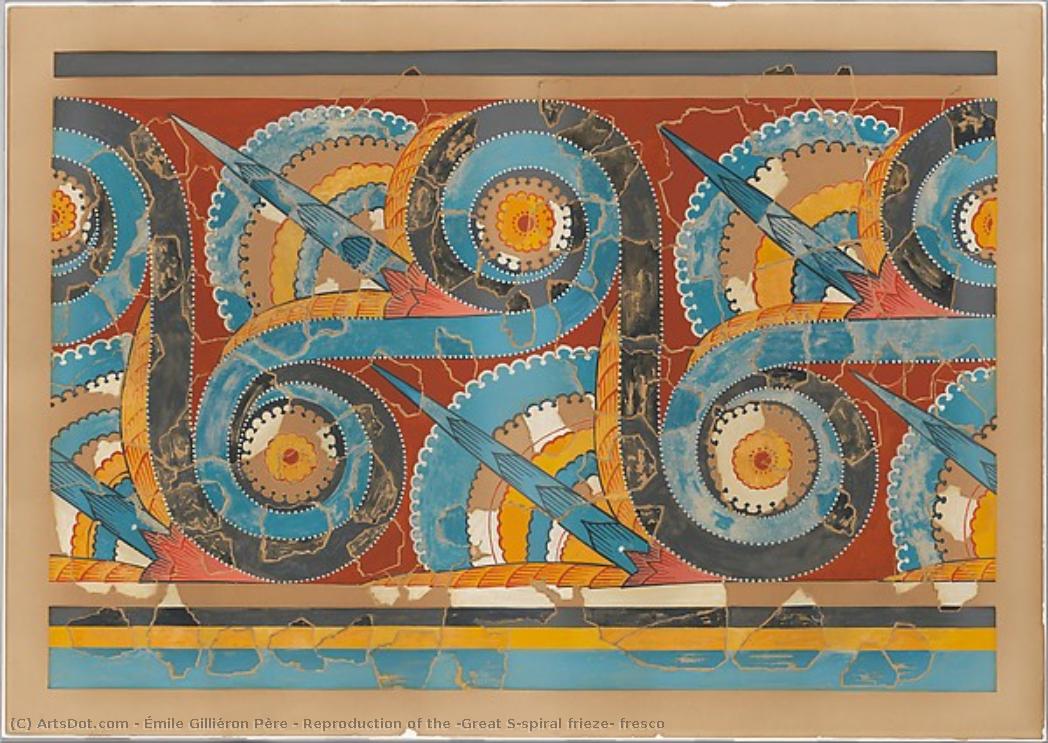
統計情報Reproduction of the "Great S-spiral frieze" fresco
 Minoan Art
 1400
1400 91.0 x 67.0 cm
 詳細を見る
詳細を見る
オンラインプレビューをはるかに凌ぐ、高解像度で鮮明なデジタル画像をご購入いただけます。
各ファイルは、社内の専門家が高度なツールと熟練した手作業によるレタッチを用いて、細心の注意を払って準備されています。すべての画像において、卓越した鮮明度、正確な色彩再現性、そして繊細なディテールを保証いたします。
最終ファイルは、プロフェッショナルな編集・印刷環境ですぐにご利用いただけるよう最適化された状態で、72時間以内にメールにてお届けいたします。これは、一流のデザインスタジオ、出版社、ギャラリーから信頼されているものと同等の品質です。
デジタルアート
個人での鑑賞、印刷、クリエイティブなプロジェクト用に、高解像度ファイルをダウンロードできます。 ( プリント版に切り替え 手描きの絵画を購入)
デジタル画像のご注文に付随する特典
高品質なデジタル画像配信を、確かな品質で。
ArtsDot.com を選ぶことは、単に画像を手に入れることではありません。それは、プロの手によって精密に仕上げられ、満足保証が付いた高品質なデジタルアートワークを受け取ることを意味します。ご注文いただいた際に自動的に付随する内容は、以下の通りです:

メールですぐにお届け
ご注文から72時間以内に、高解像度のデジタル画像ファイルがメールでお手元に届きます。すぐにそのままご利用いただけます。

AI技術で最適化されたデジタルファイル
お客様の作品は、高度なAIツールと専門家による手作業の編集を組み合わせてプロフェッショナルに最適化されており、細部のディテール、鮮明さ、そして正確な色再現性を最大限に引き出しています。

一生涯無料の再送サービス
ファイルを誤って削除したり、紛失してしまったりしましたか?ご安心ください。いつでも無料で再送いたします。

輸入手数料は一切かかりません
関税や手数料、配送料を気にすることなく、お気に入りのアートワークをすぐにお楽しみいただけます。デジタルダウンロードは常に免税です。

色彩再現の保証
プロ仕様のツールとカラーマネジメント技術を用いることで、デジタル画像が元の色を最大限に忠実に再現することを保証いたします。

100日間満足保証
ご購入いただいたデジタル画像にご満足いただけない場合は、100日以内であれば、理由を問わず修正または100%の返金対応をさせていただきます。

100% 返金保証
ご満足いただけない場合は、デジタルファイルを受け取ってから100日以内であれば、理由を問わず全額返金いたします。

まとめ買い割引
3枚購入で10%OFF - 5枚購入で15%OFF - 10枚以上購入で20%OFF。クリエイティブなプロジェクト、ギャラリー、エージェンシーに最適です。
関連作品








作家の略歴
The Linguistic Cartographer: Unveiling the Life and Work of Émile Gilliéron
Émile Gilliéron, a name perhaps less familiar than those of his Impressionist contemporaries, nevertheless occupies a pivotal position in the intellectual landscape of late 19th and early 20th century France. Born in 1855 in Mâcon, Burgundy, Gilliéron wasn’t a painter wielding brushstrokes on canvas, but a philologist armed with a meticulous ear and an insatiable curiosity for the living language spoken across his homeland. His life's work – a monumental linguistic survey of France – fundamentally reshaped our understanding of dialectology, geography, and even national identity. Gilliéron’s early education instilled in him a deep appreciation for classical languages, but it was during his time as a secondary school teacher that he became acutely aware of the vast discrepancies between the standardized French taught in classrooms and the vibrant, often unintelligible, vernaculars spoken by the people he encountered. This realization sparked a lifelong quest to document and analyze these regional variations, believing they held keys to understanding France’s history, culture, and the very evolution of language itself. He wasn't merely cataloging words; he was mapping the soul of a nation through its speech.A Revolution in Linguistic Methodology: The *Atlas Linguistique de la France*
Gilliéron’s most enduring legacy is undoubtedly the *Atlas Linguistique de la France* (ALF), an ambitious project begun in 1897 and completed posthumously in 1968. Prior to the ALF, dialectology was largely a historical-comparative discipline, reconstructing proto-languages from written sources. Gilliéron pioneered a radically different approach: direct fieldwork. He dispatched teams of investigators – often young teachers – across France, equipped with standardized questionnaires designed to elicit responses to over 1500 carefully chosen questions covering all aspects of daily life, from agricultural practices and domestic routines to folklore and local customs. The investigators didn’t simply record the words themselves; they meticulously noted pronunciation, intonation, and even the social context in which each utterance was made. This emphasis on *real* speech, as opposed to literary representations, marked a turning point in linguistic research. The resulting atlas – a vast collection of maps illustrating the geographical distribution of thousands of linguistic features – wasn’t just a scientific document; it was a breathtaking visual representation of France's cultural diversity. It revealed that language wasn’t a homogenous entity imposed from above, but a complex mosaic shaped by local conditions and historical contingencies.Influences and Intellectual Context: From Historical Philology to Regionalism
Gilliéron’s work emerged at a crucial juncture in French intellectual history. The late 19th century witnessed a growing interest in regional identities, fueled by the rise of nationalism and anxieties about centralization. While Gilliéron himself wasn't explicitly a political activist, his research resonated deeply with those advocating for greater recognition of France’s diverse cultures. He drew heavily from the methods of historical geography, recognizing that linguistic boundaries often reflected ancient administrative divisions, migration patterns, and trade routes. His intellectual debt to scholars like Paul Vidal de la Blache, a pioneer in human geography, is undeniable. Furthermore, Gilliéron’s meticulous attention to detail and his emphasis on empirical observation aligned with the broader positivist movement of the era. However, he transcended simple empiricism by recognizing that language wasn't merely a passive reflection of external factors; it was an active force shaping perceptions and constructing social realities. He understood that each dialect embodied a unique worldview, a particular way of experiencing and interpreting the world.Major Achievements and Lasting Impact: Beyond the Atlas
The *Atlas Linguistique de la France* remains Gilliéron’s most celebrated achievement, but his contributions extended far beyond this monumental project. He developed a sophisticated theory of linguistic boundaries – “lines of isoglosses” – demonstrating that dialects weren't separated by abrupt divisions, but rather by gradual transitions and overlapping zones of influence. He also pioneered the study of onomastics – the investigation of place names – revealing how toponyms could provide valuable insights into historical settlement patterns and cultural landscapes.- His work challenged the prevailing notion of a unified French language, exposing its inherent regional variations.
- He laid the foundations for modern sociolinguistics, recognizing the social factors that influence linguistic behavior.
- The ALF served as a model for similar linguistic surveys conducted across Europe and beyond.
